Proptech Briefing
1) Key Takeaways
MIPIM 2026 confirms that proptech has moved into the main programme, not the margins: this year’s official agenda put AI disruption, data centres, Housing Matters! and the road to net zero at the centre of the conference, with Philippe Aghion’s keynote explicitly framing innovation as a driver of productivity, resilience and sustainable urban development. So what? Real estate technology is no longer being discussed as an optional add-on; it is now being judged by how directly it influences capital allocation, delivery, underwriting and long-term asset performance. mipim.com · mipim.com · linkedin.com
Digital infrastructure just became a more serious real estate prize: Meter’s acquisition of WiredScore signals that connectivity, internet infrastructure and smart-building certification are being pulled closer together into a single owner/operator stack. So what? The market is moving beyond “smart building” as a badge and toward digital infrastructure as a core leasing, occupier and operating requirement - good news for platforms that sit closer to the plumbing of buildings rather than the presentation layer. wiredscore.com · bisnow.com
Agentic AI is moving the industry from pilots to workflow redesign: McKinsey now estimates $430bn–$550bn of annual value could be unlocked globally across real estate, construction and development if companies redesign domains such as maintenance, leasing, investing and construction around people-agent collaboration rather than isolated AI use cases. So what? This is where the CFO conversation starts to change: buyers should increasingly push for outcome-based pricing and measurable ROI rather than paying simply for another licence and another dashboard. mckinsey.com · mckinsey.com
Fresh capital is backing “real workflow” and “real world” built-environment tech: VerbaFlo’s Pi Labs-led seed round underlines investor appetite for AI communications layers embedded in leasing and resident operations, while AIRMO’s funding shows that the built-environment opportunity is not just software, but also physical-world intelligence around emissions, energy and infrastructure. So what? The winning companies are increasingly the ones that connect software, data and messy real-world constraints rather than simply wrapping AI around legacy processes. tech.eu · esgtoday.com · linkedin.com
Housing confidence is improving, but SME delivery conditions still look difficult: HBF’s inaugural SME Developer Sentiment Survey found low buyer confidence (63%), wider housing market conditions (61%), planning delays (76%) and viability pressures (57%) were all major constraints on delivery. So what? Better rates and better sentiment help, but if planning and viability remain this hard, the most valuable proptech will still be the platforms that unlock viable sites, improve evidence, reduce friction and de-risk delivery. hbf.co.uk · hbf.co.uk
Non-bank lending is moving into a tougher governance era: the collapses of Century Capital and Market Financial Solutions, followed by FCA and Bank of England scrutiny, are already prompting more due diligence on funding lines, just as the Iran war has pushed mortgage funding costs higher. So what? Originators with weak controls, concentrated funding or poor collateral governance should expect a higher cost of capital; the premium will increasingly go to platforms that can prove governance, transparency and disciplined underwriting. mortgagesolutions.co.uk · reuters.com · globalcapital.com · reuters.com
2) VC/PE Investment Activity
VerbaFlo secures a $7m / £5.2m seed round led by Pi Labs to build an AI communications platform for global real estate, automating leasing, operations and resident engagement. So what? This is exactly where AI is most likely to stick in property: repetitive, fragmented, high-frequency communications workflows where the ROI is visible quickly and the data flywheel improves with scale. tech.eu · uktech.news · thesaasnews.com
AIRMO raises €5m to accelerate space-based greenhouse-gas monitoring, with Pi Labs following on. It is not “classic proptech”, but it squarely sits in the built-environment intelligence stack around emissions, infrastructure and climate accountability. So what? As net zero shifts from reporting aspiration to financing and asset-level accountability, physical-world sensing and verification tools will become increasingly relevant to owners, lenders and developers. esgtoday.com · eu-startups.com
Meter acquires WiredScore to combine building connectivity infrastructure with WiredScore’s certification footprint across more than 1,000 landlords in 42 countries and 1bn sq ft of real estate. So what? This is a meaningful strategic M&A signal that buyers increasingly want integrated digital-building infrastructure, not a patchwork of certifications, connectivity vendors and smart-building overlays. wiredscore.com · bisnow.com
Bedrock Robotics’ $270m Series B stands out as one of the largest construction‑tech rounds ever, funding operator‑less excavator deployments and fully autonomous site operations from 2026 onwards. So what? Construction robotics is finally being funded at the scale of the problem; for developers and contractors, this is a prompt to start planning how autonomous equipment, digital twins and AI scheduling will change procurement and risk profiles over the next cycle. prnewswire.com
Nscale raises $2bn (£1.5bn) in a huge Series C to expand AI data-centre capacity. Again, this sits adjacent to proptech rather than inside it - but MIPIM made clear that data centres are now core real estate, not a side category. So what? Capital is flowing hard into the physical infrastructure AI needs, and that will keep pulling planning, energy, grid and industrial land issues further into the mainstream real estate conversation. uktech.news
Proptech capital remains concentrated, not broad-based: by CRETI’s count, 2025 proptech funding reached $16.7bn (+67.9% YoY), with January 2026 already running hot and much of the capital funnelled into larger AI-led rounds. So what? Founders should not confuse a recovery in total dollars with an easy market - capital is back, but it is discriminating hard between scalable platforms and interesting-but-thin products. bisnow.com · theaiconsultingnetwork.com · pilabs.vc
3) Market Insights
CrowdProperty’s March State of the Market describes a disciplined rather than exuberant market: house prices broadly stable, mortgage pricing volatility returning as Middle East tensions lift swap-rate pressure, build-cost inflation easing but margins still tight, and residential planning applications beginning to rise. So what? The market is improving, but the operating environment still rewards disciplined underwriting, margin control and live visibility on exit liquidity. crowdproperty.com
SME homebuilder sentiment is now giving us a clearer read on what is really blocking supply: HBF’s March survey shows buyer confidence and market conditions remain major demand-side issues, while planning delays and viability pressures dominate the supply side. So what? Anyone still framing the housing challenge as simply “build more” is missing the operational reality; the bottlenecks are confidence, planning speed and scheme economics. hbf.co.uk · hbf.co.uk
MIPIM’s mood shifted from geopolitical caution back to real estate fundamentals surprisingly quickly: CoStar’s wrap-up noted an early downbeat tone because of the Iran conflict and travel disruption, but by mid-week the discussion had moved back to recovery, investor appetite and the sectors with the strongest fundamentals - with residential and data centres repeatedly cited. So what? Capital still wants to deploy, but it is doing so with more sensitivity to funding costs, energy, and physical bottlenecks than it had even six months ago. costar.com · cbre.co.uk
Investor attention is continuing to rotate toward infrastructure-like real estate themes: private markets commentary suggests infrastructure now represents a growing share of private markets, with data-centre growth a major driver. So what? This reinforces what MIPIM made visible on the ground: technology in the built environment is increasingly tied to hard assets, long-duration capital and utility-style constraints rather than just software adoption cycles. realassets.ipe.com · pwc.com
AI infrastructure capital continues to dwarf classic proptech rounds: commentary around March’s market makes clear that the biggest cheques are increasingly flowing into the compute, data-centre and physical infrastructure layers that AI needs, not just application software. So what? For built-environment founders, this is a reminder that some of the most valuable opportunities sit where real estate, power, land and digital infrastructure intersect - not just in workflow SaaS. bebeez.eu · pwc.com
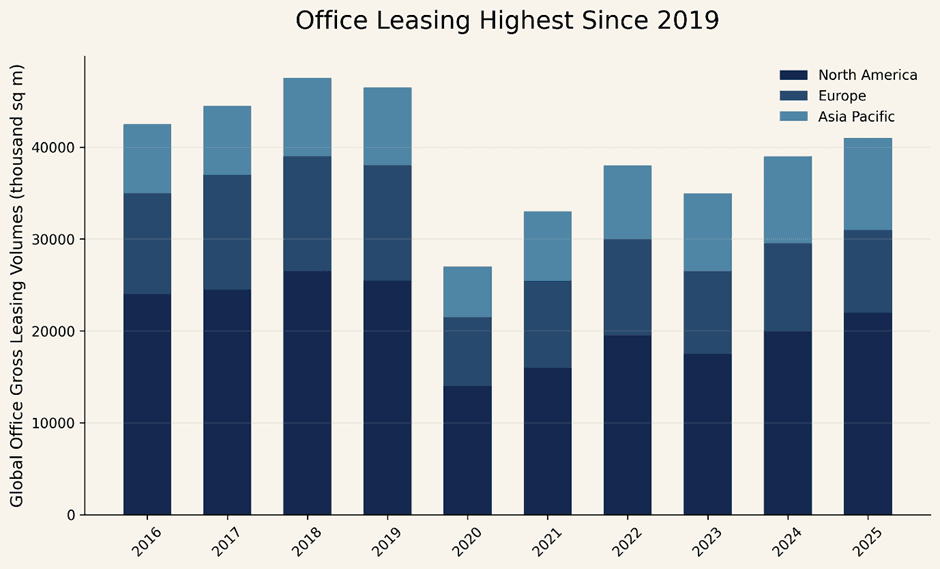
JLL’s Global Real Estate Perspective (February 2026) highlights a new post‑pandemic high in global office leasing in 2025, strengthening capital‑markets momentum, and continued strength in logistics and data‑centre demand. So what? For proptech, this is a friendlier macro environment: as leasing and capex plans recover, owners and occupiers are more willing to back platforms that accelerate deals, fit‑out, retrofit and data‑driven asset management. jll.com
4) Chart of the Month
HBF SME Developer Sentiment Survey (March 2026) - “planning delays, not just demand, are choking supply”
The cleanest chart this month is HBF’s new SME developer sentiment data: planning delays were cited by 76% of respondents as a top-three supply-side constraint, low buyer confidence by 63%, housing market conditions by 61%, and viability pressures by 57%.
So what? This is a much more useful picture of the housing market than headline house-price chatter. It shows exactly why the best proptech opportunities still sit in planning intelligence, viability modelling, funding, evidence-building and delivery workflows - the places where schemes live or die.
Source: HBF SME Developer Sentiment Survey, March 2026 - hbf.co.uk and hbf.co.uk
5) Number of the Month
$430bn–$550bn - McKinsey’s estimate of the annual value agentic AI could unlock globally across real estate, construction and development.
So what? Set against today’s $10–20bn annual funding into proptech, that range underlines how much upside remains on the table - and why boards, LPs and strategics are increasingly asking where they should actually apply agentic AI rather than whether they should look at AI at all. For buyers, it also strengthens the case for outcome-based pricing models that make ROI clearer and investment cases easier to get past the CFO. mckinsey.com
6) Operator Play of the Month
AI communications layers for real estate operators. VerbaFlo’s Pi Labs-led round is a good example of where real estate AI is getting practical: not “AI for the sake of AI”, but systems that automate the leasing, resident and operational communication load that sits between property teams and customers.
So what? This is exactly the kind of operator-facing infrastructure that can become sticky. It touches revenue, service levels and labour efficiency at the same time - and it is much easier to justify than broad “AI transformation” pitches that never make it into daily workflows.
7) Policy & Regulation Radar
Digital planning still looks like one of the more concrete implementation opportunities in UK proptech: the Local Digital / English Digital Planning Programme continues to fund digital planning tools, while HBF’s new SME survey underlines just how central planning delays remain to delivery. So what? The market signal is consistent: planning and GIS-focused platforms that can plug into standardised data, evidence and workflow infrastructure remain one of the clearest problem/solution fits in UK proptech. localdigital.gov.uk · localdigital.gov.uk · hbf.co.uk
The MFS collapse is becoming a regulatory and governance issue, not just a lender failure: Reuters reports the FCA has opened an enforcement investigation, while the Bank of England’s prudential arm has requested information from lenders about their exposures and due diligence. So what? Non-bank lenders, specialist originators and their funding partners should expect more scrutiny on collateral, connected-party exposure, controls and governance - which in turn pushes the premium toward higher-quality platforms and away from opaque or lightly controlled origination models. reuters.com
8) Deep Dives on Hot Topics
Special: MIPIM 2026 - From Preview to Proof
March’s biggest reality check came in Cannes. MIPIM 2026 did not just talk about proptech and AI as fringe innovation themes; it placed them directly inside the main programme. The official agenda leaned into AI disruption, data centres, Housing Matters! and the road to net zero, and the post-event MIPIM summary confirms that both Housing Matters! and the new Data Centres Summit saw exceptional attendance. Philippe Aghion’s keynote set the tone by framing AI as something that needs responsible control so that it serves public interest and sustainable urban development. That is a very different framing from “which tool should we buy?” mipim.com · mipim.com · linkedin.com
What struck me most is that the conference themes I flagged in my preview piece did, in fact, show up in the market chatter. CoStar’s wrap-up notes that topics ranged from finding data-centre and life-science sites to navigating AI and proptech change, while CBRE’s own MIPIM retrospective put AI-ready infrastructure, data-centre growth and sustainable development at the heart of its summary. Colliers then picked up the same thread afterwards, describing the data-centre conversation at MIPIM as “standing-room only”. In other words, the built environment is not just talking about software; it is talking about the physical constraints - land, power, planning, cooling and capital - that AI is now forcing into the centre of real estate strategy. costar.com · cbre.co.uk · colliers.com
One of the more useful signals from the conference is that AI content was not confined to generic innovation panels. MIPIM’s own programme included sessions such as “AI in Real Estate Investment: What’s Being Used, What’s Possible, and What’s Next?” and “Real Estate 2026: What AI Changes for Developers”, showing that the discussion has moved from novelty to application in investment and development workflows. So what? That matters for attendees trying to skill up: the most valuable sessions are no longer the ones that ask whether AI matters, but the ones that explore where it changes decisions, execution and returns. mipim.com · mipim.com
So what? MIPIM 2026 reinforced a structural shift: proptech is no longer competing for attention within real estate. It is embedded in the conversations about capital deployment, urban productivity, digital infrastructure, housing delivery and the net-zero transition. That is good news for serious founders and investors - but it also raises the bar. The technology that wins attention now is the technology that changes outcomes.
Proptech × Fintech Intersect
The MFS / Century Capital failures are now being read as a governance event for specialist lending, not just a pair of unlucky collapses. Century entered administration in early February; MFS followed, and Reuters now reports an FCA enforcement investigation, a creditor shortfall above £1.3bn, and Bank of England information requests focused on lender due diligence. GlobalCapital says the news could cause bank funding to dry up, while Mortgagesolutions reports brokers already expect more due diligence on funding lines. So what? The non-bank lending sector is moving into a “flight to quality” phase: governance, collateral discipline, funding diversity and auditability will matter more, and weaker originators should expect capital to get more expensive. mortgagesolutions.co.uk · reuters.com · reuters.com · globalcapital.com · mortgagesolutions.co.uk
The Iran war has compounded the problem by feeding directly into mortgage funding costs. Reuters reports UK two-year fixed mortgage rates rising from 4.83% to 5.51%/5.52%, with 21% of mortgage products withdrawn since the conflict began. So what? Even if the housing market’s underlying direction is improving, cost-of-capital shocks still transmit quickly into exits, refinancing and transaction liquidity - especially for SME developers and originators that depend on predictable end-borrower affordability. reuters.com · crowdproperty.com
Funding partners are likely to demand more than origination volume going forward. So what? Reporting quality, controls, auditability and governance are becoming more important drivers of funding-line access and cost than they were in the easy-money phase.
AI in Real Estate
McKinsey’s latest work on agentic AI is probably the most useful single piece published this month for property leaders. It argues that the industry should stop asking “Which use cases can we pilot?” and start asking “Which workflows should we redesign so the software is allowed to do the work?” across maintenance, leasing, investing and construction. So what? The next wave of value will not come from chatbots bolted onto old processes; it will come from redesigning domains end-to-end, with controls, data quality and measurable outcomes built in. mckinsey.com · mckinsey.com
MIPIM itself offered a good clue as to where buyers are trying to learn fastest: not just about AI tools, but about how AI changes investment, development and building operations in practice. So what? If you are selling into real estate, the burden of proof is rising - buyers increasingly want fewer point solutions, tighter integration, and commercial models that line up clearly with measurable outcomes. mipim.com · blog.mipimworld.com
VerbaFlo, Elyos and the latest wave of property/field-service AI tell the same story in different guises: AI is winning where it reduces friction in leasing, communications, trades and service delivery rather than where it simply produces prettier outputs. So what? This is why buyer discipline matters: insist on products that move a real KPI - speed to lease, response time, conversion, cost to serve - and the ROI conversation becomes much easier. tech.eu · eu-startups.com · uktech.news
AIRMO is a good reminder that some of the most interesting built-environment innovation will come from “physical-world AI” rather than traditional proptech categories. Monitoring emissions from space may feel one step removed from real estate, but it fits neatly with a world in which asset owners, lenders and regulators need better measured performance, not just design-stage promises. So what? The built environment is going to absorb more sensing, monitoring and verification technology as sustainability expectations move from rhetoric to evidence. esgtoday.com · eu-startups.com
MIPIM and the broader March commentary made clear that AI in real estate is not just about software. Data centres, energy, physical infrastructure and planning are now all part of the same conversation. So what? The biggest opportunities in the built environment increasingly sit where digital intelligence meets hard physical constraints - power availability, grid economics, site selection, planning certainty and operational delivery. mipim.com · cbre.co.uk · colliers.com · linkedin.com
The best lens I have seen recently on where the next AI winners may come from is not actually a pure proptech article, but my write-up from Goldman Sachs’ 11th Disruptive Technology Symposium. The big takeaway there was that power, distribution, physical AI and sovereign compute keep showing up as the real bottlenecks. So what? That matters directly to the built environment: software is only one side of the opportunity; infrastructure, energy and physical execution still decide who captures value. linkedin.com
9) Events
UKREiiF, Leeds, 19-21 May 2026 - ukreiif.com
London Tech Week, London, 8–12 June 2026 - londontechweek.com
Real Estate:UK Annual Conference 2026, London, 7 July 2026 - ukproptech.com
PropTech Connect Europe, London, 9-10 Sep 2026 - proptechconnect.com
UK Events Programme: UK PropTech Association (UKPA) Events - ukproptech.com
Global events calendar – PropTechVision: proptechvision.com
10) Further Reading
Inside Goldman Sachs’ 11th Disruptive Technology Symposium: The AI Winners Won’t Be Who You Think. So what? A useful lens on why power, distribution, physical AI and sovereign compute matter far beyond “software”. linkedin.com
JLL Global Real Estate Perspective – February 2026. So what? Board‑friendly overview of macro, leasing and capital‑markets trends, helpful as an anchor for 2026/27 strategy. jll.com
How agentic AI can reshape real estate’s operating model (McKinsey). So what? The clearest current framework for moving from AI pilots to real operational value. mckinsey.com
Global private markets in real estate (McKinsey). So what? Useful on the market cycle - and one of the clearest places McKinsey quantifies the $430bn–$550bn annual value potential from agentic AI. mckinsey.com
Is 2026 the year AI changes real estate? (MIPIM World). So what? A useful companion piece to the conference itself, especially for readers wanting a quick read on how the official MIPIM ecosystem is framing AI adoption across the sector. blog.mipimworld.com
MIPIM 2026: Where Proptech Meets Capital, Infrastructure and Reality.So what? A more detailed field guide to the conference themes, the real tech signal, and what attendees should actually pay attention to. linkedin.com
Dubai Land Department: Real Estate Tokenisation (project overview). So what? The primary‑source reference for one of the most advanced, state‑backed tokenisation infrastructures now moving into secondary‑market trading. dubailand.gov.ae
Market Financial Solutions falls, shaking investor confidence in bridging lenders (GlobalCapital). So what? One of the clearest summaries of why the MFS failure matters beyond MFS. globalcapital.com
State of the Market – March 2026 (CrowdProperty). So what? A concise, actionable read on mortgage repricing, build costs, planning applications and developer discipline. crowdproperty.com
SME Developer Sentiment Survey – March 2026 (HBF). So what? Probably the best fresh evidence this month on what is really constraining SME housing delivery. hbf.co.uk · hbf.co.uk
For UK residential property market insights, subscribe to the CrowdProperty UK newsletter – linkedin.com
For Australian residential property market insights, subscribe to the CrowdProperty Australia newsletter – linkedin.com
Mike Bristow
Founder of Growth Strategy. Operator, advisor and investor across strategy, capital, M&A and board roles.
About Mike
More perspectives
Strategy & Growth
Make sharper choices, build sustainable advantage and turn strategic intent into measurable enterprise value.
Capital
Secure and optimise the institutional capital required to lend, invest, acquire, build or scale.
M&A & Transactions
Prepare, position and execute acquisitions, disposals, liquidity events and strategic partnerships.
Board & Executive
Add experienced judgement, challenge and execution capacity at board and executive level.