Proptech Briefing
1) Key Takeaways
Britain has a new Prime Minister, and housing is central to his pitch: Andy Burnham was sworn in on 20 July after Keir Starmer’s resignation, and immediately reappointed Angela Rayner as Housing Secretary and John Healey as Chancellor. Rayner has confirmed Labour is keeping its 1.5 million homes target while calling it a “really difficult stretch target”, and has ruled out rent controls. So what? A change of Prime Minister rarely changes a market overnight, but it resets the political incentives around planning, tax and delivery just as the housebuilding pipeline is at its weakest in a decade. See the deep dive below. crowdproperty.com · constructionnews.co.uk
One robotics round is bigger than the rest of the month’s built-environment tech deals combined: Travis Kalanick’s industrial-AI holding company Atoms raised $1.7bn led by Andreessen Horowitz, with Fifth Wall, Bain Capital and, pointedly, Uber among the backers. So what? Physical AI is attracting mega-rounds that dwarf anything proptech has produced this cycle. When a single robotics bet is worth more than nine other major built-environment tech raises combined, it says as much about where generalist capital is chasing conviction as it does about construction specifically. techcrunch.com
Balfour Beatty becomes the first UK tier-one contractor to invest directly in a VC fund: Balfour Beatty has committed £10m to Pi Labs’ £100m Fund IV as a cornerstone investor. Fund IV is built specifically to back agentic AI and robotics across the entire real assets value chain, and the commitment gives Balfour Beatty early access to up to 50 early-stage construction and infrastructure technology businesses, with its live sites opening as a testing ground from October. So what? Corporates are no longer waiting for technology to mature before engaging with it; they are buying a seat at the table where it is being built. Expect more tier-one contractors to follow Balfour Beatty into direct fund relationships rather than one-off pilots. (Disclosure: I am a Pi Labs Venture Partner and Investment Committee member.) balfourbeatty.com · constructionnews.co.uk
UK lettings consolidation is accelerating, not cooling: Dwelly raised $170m in Series B funding (co-led by EQT Growth and General Catalyst) just five months after a $93m round, taking total funding past $260m as it acquires independent letting agencies and replaces their back offices with AI. So what? Fragmented, low-tech markets are exactly where roll-up-plus-AI economics work best: buy the customer relationships, strip out the manual admin, and the margin improvement funds the next acquisition. The UK’s ~20,000 independent letting agencies are the addressable market for this thesis, and Dwelly is not the only one pursuing it - Street Group’s Hg-backed valuation of over £200m this month tells a similar story about vertical software consolidation in the same corner of the market. bloomberg.com · sifted.eu
The housing market is stabilising, but only just: CrowdProperty’s July State of the Market shows UK house prices edging up 0.2% in June (Lloyds), the Bank of England holding its base rate at 3.75% for several consecutive meetings, and developers concentrating bids on 75-200 home schemes while avoiding larger, infrastructure-heavy sites. So what? Stability is not the same as recovery. Affordability remains the binding constraint on demand, and disciplined appraisals - not improving conditions - are now the main differentiator between developers who get funded and those who don’t. crowdproperty.com
2) VC/PE Investment Activity
Prolo raises £4.2m seed funding: Triple Point Ventures led an oversubscribed round into Prolo’s AI-powered procurement platform for SME construction firms, with participation from the a16z Scout Fund, Anamcara Capital, Concrete VC, Haatch, Koro Capital, Love Ventures and Portfolio Ventures. Prolo combines AI and human procurement specialists to source materials, equipment and plant hire from a network of 185+ suppliers, and offers contractors up to 90 days’ credit. So what? Procurement is one of construction’s last genuinely manual functions, and the 90-day credit feature turns a sourcing tool into a working-capital product - a smart move in a sector where payment delays, not just prices, drive project risk. (Disclosure: I am an investor in Prolo.) tech.eu · techfundingnews.com
Monumental raises $32m Series B to scale construction robots: Khosla Ventures led the round, with existing investors Plural and Hummingbird also participating. Monumental’s bricklaying robots have now built exterior walls for 100+ homes and a school, community centre and hotel in the Netherlands and UK, with a fleet of 150+ robots; the company plans a US launch this year and charges customers for finished walls rather than for the robots themselves. So what? The pay-for-output model is the more important signal than the robot itself: it removes the capex and technical risk that has historically stalled construction-robotics adoption, and it is a template other hardware-heavy contech companies are likely to copy. sifted.eu · therobotreport.com
Pi Labs passes 100 investments: 10 years, 4 funds, 20 exits, 15 countries, and now 100 investments. Founder and Managing Partner Faisal Butt marked the milestone this month in a Property Week interview with Ian Weinfass, tracing the journey from his first pitch as a student in 2009 through a decade backing real estate and construction technology to today’s deployment of the £100m Fund IV. Butt’s argument: real estate and construction have long been among the slowest industries to adopt new technology, but that is changing as the underlying tech stack matures and boards actively lean into what AI can do, rather than resist it. So what? Butt’s own framing is the sharpest: he believes the built world’s next unicorn will be an agentic AI startup - the same thesis Fund IV, Balfour Beatty’s cornerstone commitment (see Key Takeaways above) and the agentic AI companies presenting at Pi Labs’ Digital Demo Day are all built around. (Disclosure: I am a Pi Labs Venture Partner and Investment Committee member.) propertyweek.com
Dwelly raises $170m Series B: See Key Takeaways above for the detail. The round comprised $95m equity (EQT Growth, General Catalyst, s16vc, Begin Capital, DVC and others) and a $75m debt facility from Trinity Capital. Dwelly now manages 15,000+ properties, making it a top-ten UK letting agency by portfolio size, with eight acquisitions completed in 2026 alone. So what? Watch the debt-to-equity mix here: a growing share of AI roll-up capital is structured debt rather than pure equity, which changes the return profile investors need and the discipline the company has to show on cash generation. techtimes.com
Street Group secures Hg growth investment at a valuation of over £200m: HgCapital Trust and other Hg institutional clients are investing via the Hg Mercury Fund, with HgT itself committing around £7m. Manchester-based Street Group (formerly Agent Software) provides CRM, prospecting and AI-agent tooling - including its Cortex product - to more than 4,000 UK estate and letting agency branches. So what? This is proof that vertical SaaS for fragmented, transaction-heavy markets can build genuine scale without a roll-up model: Street Group has grown organically to a £200m+ valuation by embedding into agents’ daily workflow rather than acquiring them outright. hgcapitaltrust.com · eu-startups.com
Atoms raises $1.7bn for industrial AI and robotics: Travis Kalanick’s Atoms - the holding company built on CloudKitchens and the Pronto mining-automation business - closed the round led by Andreessen Horowitz, with Ben Horowitz joining the board. See Key Takeaways above for the wider context. So what? Atoms operates across food, mining and transport rather than real estate directly, but Fifth Wall’s presence in the syndicate, and the sheer scale of committed capital to “physical AI”, is a signal every construction-robotics founder and investor should be watching. techcrunch.com
PropTech Connect’s July flow also points to breadth beneath the headline rounds: Higharc raised a $95m Series C to extend its AI homebuilding platform into the building-materials supply chain via a new US LBM partnership, Furbnow raised £2.5m seed to scale UK home energy retrofits, Uniti raised $12m Series A to build an agentic AI layer for global real estate operators, TerraFirma raised $115m to accelerate construction, Cascade raised $3.5m for construction firms, Fuchs & Eule raised €10m to scale its AI-powered building-retrofit platform for European landlords, and Modo Energy secured $17m in growth funding from CIBC Innovation Banking. So what? AI, energy retrofit and construction-adjacent capital is spreading across geographies and sub-sectors; the common thread remains recurring workflows, distribution advantage and measurable ROI rather than any single hot category. higharc.com · proptechconnect.com · proptechbuzz.com · proptechconnect.com
3) Market Insights
House prices edge up, but affordability still caps growth: The Lloyds House Price Index shows UK prices rising 0.2% in June - the first monthly rise in four months - taking the average property to £299,330 and annual growth to 0.6%. Mortgage rates have eased from their highs, but household budgets remain under pressure. So what? A market that is stabilising rather than recovering rewards realistic pricing over optimism. Developers should keep underwriting against local purchasing power, not against the hope that rate cuts alone will restore demand. crowdproperty.com
Rate stability is real, but borrowing costs remain elevated: The Bank of England has now held its base rate at 3.75% for several consecutive meetings, reducing volatility across mortgage pricing even as costs remain well above the previous decade’s ultra-low-rate norm. So what? Stability helps forecasting, but it is not the same as cheap capital. Developers should keep structuring projects with headroom rather than assuming rate cuts will bail out thin appraisals. crowdproperty.com
The national average is masking a two-speed market: ONS data show UK house prices up 2.7% in the year to May, but London fell 3.7% - its ninth consecutive annual decline, driven by Inner London boroughs such as Westminster and Tower Hamlets - while the North East led growth at 5.9%. UK rents rose 3.3% to £1,388 in June, with rent inflation ranging from 6.3% in the North East to just 2.2% in London. So what? A single national house-price figure is an increasingly poor underwriting tool. Local supply, affordability and tenure conditions - not the headline average - should be driving pricing and product decisions. ons.gov.uk
Developers are retreating to smaller, lower-risk sites: Savills’ Q2 development land research shows bidding held up reasonably well for schemes of 75-200 homes, while appetite fell for larger sites carrying heavy infrastructure obligations and longer delivery programmes; brownfield and urban schemes remain the hardest to make viable. So what? Land buying has become a viability exercise before it is a growth strategy. Scale is only an advantage if the delivery risk that comes with it can be priced and funded. crowdproperty.com
London’s own housing target quietly concedes the delivery problem: The Mayor’s new draft London Plan targets 558,000 homes by 2037 - a 20-year horizon, a 38% cut from last year’s proposed figure, and one City Hall’s own planning director has called “credible” precisely because the government’s assessed need for the capital is not. So what? When the country’s largest and best-resourced planning authority sets a target it openly frames as more deliverable than the national one, that is a data point on the 1.5 million homes target as much as it is a London story. See the deep dive below. propertyweek.com · housingdigital.co.uk
Construction activity is still contracting, just more slowly: BCIS’s latest industry survey suggests the pace of contraction across construction is easing, though activity remains subdued; Construction Enquirer separately reports output fell for a second consecutive month in June, driven entirely by a 2.1% drop in the volatile repair-and-maintenance segment, even as new work edged up 0.2%. So what? “Less bad” is not the same as growth. Cost discipline, realistic programmes and robust contingencies remain the difference between a viable scheme and a stalled one. constructionenquirer.com · crowdproperty.com
4) Chart of the Month
The Gap Is Widening Again.
Labour’s manifesto commitment is 1.5 million net additional homes in England over this Parliament. The chart tracks the rolling five-year total of net additional dwellings actually delivered - the most complete official measure, and the one that smooths out single-year noise. The latest complete reading, for 2024-25, is 1.11 million: about 390,000 short of the target, and falling for the second year running after peaking in 2022-23:
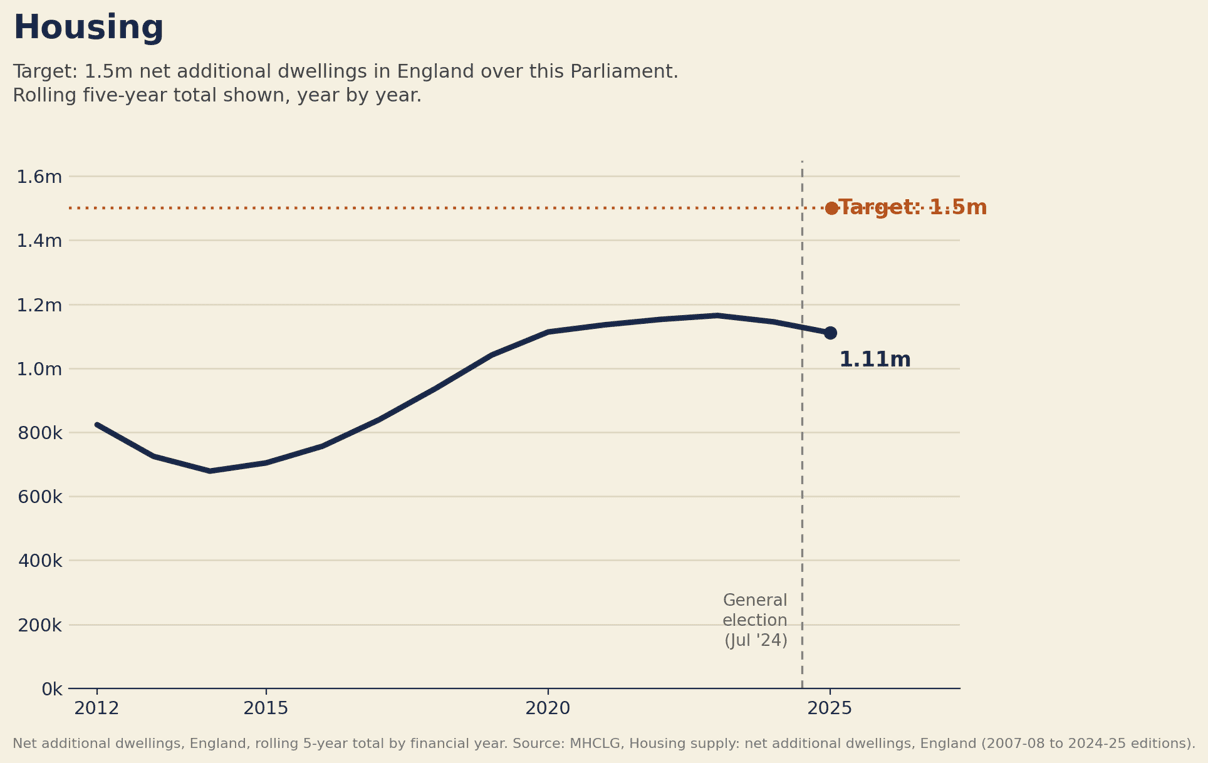
The annual data underneath the trend confirm it, and the leading indicator is worse than the lagging one. England delivered 208,600 net additional homes in 2024-25 - the most recent complete year - down 6% on 2023-24 and 16% below the 2019-20 pre-pandemic peak. But building reflects permissions granted two to three years earlier, and today’s permissions pipeline is thinner still: planning permission was granted for just 208,000 homes in the year to September 2025, down 15% on the year before, the lowest 12-month total since 2013 and 38% below the early-2022 peak. That is the number to watch, because it is the one that determines whether 2027 and 2028 look any better than 2025 - and right now it is still falling, not turning.
So what? This isn’t a delivery problem that better rhetoric or a retained target fixes on its own. It’s an approvals problem, a finance problem and a capacity problem stacked on top of each other, and it needs a fundamental step change across all three - not incremental improvement - to close a gap of this size. On the evidence available, that step change is nowhere near starting: the leading indicator is still deteriorating, not stabilising. Retaining the 1.5 million target, as Rayner has done this month, does not by itself change the trajectory shown here; only a change in the trajectory does. Watch the 2025-26 completions print, due around the Autumn Budget window, and above all watch permissions data over the next few quarters - if approvals keep falling, the delivery line falls with them regardless of what any minister says this month.
Source: MHCLG, Housing supply: net additional dwellings, England (accredited annual editions, 2007-08 to 2024-25); MHCLG, Housing supply: indicators of new supply, England: July to September 2025 (Glenigan planning permissions data); HBF/Glenigan Housing Pipeline report, Q3 2025. gov.uk · gov.uk · hbf.co.uk
5) Number of the Month
7 - the number of times the UK Housing Secretary role has changed hands in the past five years. Angela Rayner’s reappointment this month, under Andy Burnham, is the latest turn of that cycle.
So what? Housing delivery depends on continuity - in planning reform, in funding programmes, in relationships between government and industry - as much as it depends on any single policy. Seven ministers in five years is itself a structural headwind to the 1.5 million homes target, independent of whatever any individual minister proposes.
6) Operator Play of the Month
Robots as an autonomous subcontractor. Monumental is the clearest operator play this month: instead of selling robots or software licences, it deploys its own fleet on live sites and invoices customers for completed walls - 100+ homes and counting, with output nearly doubling quarter-on-quarter.
So what? For contractors facing the UK’s estimated shortfall of 20,000+ bricklayers, the operational question is no longer “should we trial robotics” but “who absorbs the deployment risk.” A pay-for-output model answers that cleanly, and it is the structure other construction-robotics companies will need to match if they want production, not pilots.
roboticsandautomationnews.com · fortune.com
7) Policy & Regulation Radar
Andy Burnham becomes Prime Minister; Rayner and Healey take the two housing-critical roles: Burnham was sworn in on 20 July, having won the Labour leadership unchallenged with 379 of 401 MPs’ support. His first cabinet reappointed Angela Rayner as Housing Secretary and installed John Healey as Chancellor. So what? Two of the government’s most housing-relevant appointments went to politicians with deep housing and local government experience. That signals continuity of ambition, not necessarily continuity of delivery - see the deep dive below. pbs.org · crowdproperty.com
Rayner keeps the 1.5 million homes target, rules out rent controls: Rayner confirmed the target remains in place despite “construction costs going up, which has had a real negative impact,” and separately ruled out rent caps, citing Scotland’s experience as evidence they suppress rather than support investment. So what? Ruling out rent controls will be read by developers and investors as a stabilising signal. Keeping the 1.5 million target without new delivery mechanisms will be read as aspirational rhetoric until the Autumn Budget shows otherwise. propertyweek.com · constructionnews.co.uk
Judicial review reforms aim to accelerate construction projects: Government proposals reported this month would narrow the grounds and timelines for judicial review challenges against major infrastructure and housing schemes. So what? This is one of the few levers that could meaningfully shorten delivery timelines without new spending. Developers should watch how far reform goes before pricing in any material change to programme risk. constructionnews.co.uk
8) Deep Dives on Hot Topics
Special: What does Andy Burnham’s premiership mean for the UK residential property market?
On 20 July, Andy Burnham was sworn in as the UK’s seventh Prime Minister in a decade, succeeding Keir Starmer, who resigned the Labour leadership on 22 June and stood down as PM once Burnham had been confirmed unchallenged as party leader. Burnham - until recently Mayor of Greater Manchester - built his campaign heavily around housing, pledging to “build more council homes” and to publish a “10-year plan” for Britain. His first cabinet reappointed Angela Rayner as Housing Secretary and installed John Healey as Chancellor: both bring substantial housing and local government experience, and both are read by the sector as a signal that housing will stay central rather than slide down the agenda.
What we know is limited so far. No new planning reforms or tax changes have been announced. What we do know is Rayner’s early positioning: she has confirmed Labour is retaining its manifesto commitment to 1.5 million homes this parliament - while explicitly calling it “a really difficult stretch target” - and has ruled out rent controls in England, citing the evidence from Scotland’s rent cap experience. She has also signalled a shift toward greater council housebuilding, arguing the state cannot rely solely on private developers building homes for market sale.
The commercial case for scepticism on the 1.5 million target has only strengthened since Rayner first set it in 2024. Savills forecasts new home completions in England averaging just 167,500 a year to 2029/30, with unsupported private completions falling to around 96,000 in 2026/27 - the lowest since 2015. Hitting 1.5 million by 2029 requires sustained delivery north of 300,000 homes a year; the market is currently running at roughly half that. Even London - the country’s best-resourced planning authority, with the strongest institutional capital base - has just set its own target at 558,000 homes over a 20-year horizon to 2037, a figure its own deputy mayor for planning has called “credible” specifically because the government’s assessed need for the capital is not. Read alongside each other, the message from the country’s most experienced housing delivery machine is that the national ambition and the deliverable reality are two different numbers, and government has not yet said which one it is planning around.
Taxation is the area to watch most closely into the Autumn Budget. No changes have been confirmed, but Burnham has previously supported reviewing Stamp Duty and Council Tax, and Propertymark has already called on Healey to conduct a broader review of housing taxation, including landlord taxation in the private rented sector. Stamp duty in particular remains a live wound: Tax Policy Associates estimates the April 2025 increase is suppressing roughly 30,000 residential transactions a year, and RSM puts Q1 2026 completions around 30,000 below the five-year quarterly average. A government serious about housing delivery and market liquidity has an obvious, evidence-backed lever available to it - whether it chooses to pull it is a genuine open question, not a formality.
Applying the operator, investor, Chair and capital lenses together: operators should expect continuity of policy direction but should not bank on planning reform accelerating faster than it has under the previous government - judicial review reform is the one genuine near-term lever, and it has not yet been legislated. Investors should treat confidence, not policy announcements, as the leading indicator: land transactions, development starts and lender appetite will move before any formal reform lands. Boards overseeing housebuilders and lenders should press management on how viability assumptions are being stress-tested against a slower, more state-involved delivery model rather than the private-market-led recovery many appraisals still assume. And capital providers should watch the Autumn Budget above everything else: it is the first moment this government’s stated priorities on housing will collide with the fiscal reality of paying for them.
As CrowdProperty’s own analysis of the transition puts it, changes in government create uncertainty, but they also create opportunity - and the developers who navigate this well will be the ones who stay adaptable, keep underwriting real projects rather than political promises, and work with funding partners who understand the market as it evolves, not as any manifesto describes it.
crowdproperty.com · constructionnews.co.uk · propertyweek.com · propertyweek.com · propertywire.com
Proptech × Fintech Intersect
Dwelly’s capital stack is the real fintech story inside its own headline: The $170m round split $95m equity and $75m debt from Trinity Capital, on top of a February raise structured the same way. The letting-agency roll-up is effectively being financed like an asset-backed lending platform, not a conventional software business. So what? As roll-up-plus-AI models mature, expect debt to make up a growing share of their capital stacks. That shifts the underwriting question from “will this grow” to “will this generate the cash to service the debt” - a much more fintech-native test than most software investors are used to applying. bloomberg.com
Prolo turns procurement into an embedded-credit product: Prolo’s AI sourcing platform now offers SME contractors up to 90 days’ credit alongside supplier pricing, addressing the payment delays that the Chartered Institute of Building links to roughly 40% of construction projects running behind schedule. So what? This is the same pattern proptech and fintech keep converging on: whoever owns the workflow is best placed to own the financing decision that sits inside it. Procurement software with embedded credit is a more defensible business than either piece sold alone. (Disclosure: I am an investor in Prolo.) techfundingnews.com
Tax policy is the property/fintech friction a new Chancellor could actually remove: Propertymark has already called on new Chancellor John Healey to conduct a broader review of housing taxation, including Stamp Duty and landlord taxation in the private rented sector, following Andy Burnham’s appointment of his cabinet. So what? Transaction technology can only compress so much friction out of a housing market; tax design sets the liquidity ceiling underneath it. A Chancellor willing to revisit Stamp Duty would do more for transaction volumes than any proptech platform could on its own - which is exactly why the Autumn Budget is the moment to watch, not this month’s cabinet appointments. crowdproperty.com
AI in Real Estate
Pi Labs is making the clearest public bet yet that the built world’s next unicorn is agentic, not merely AI-assisted: Faisal Butt’s Property Week interview and the £100m Fund IV both stake Pi Labs’ thesis on agentic AI and robotics across the real assets value chain - systems that act, not just tools that analyse or suggest. So what? The distinction matters commercially: AI-assisted tools save time on a task a human still owns; agentic systems take on the task itself, with all the liability, trust and change-management questions that implies. Investors and boards should be asking which category a given “AI” claim actually falls into before pricing it. (Disclosure: I am a Pi Labs Venture Partner and Investment Committee member.) propertyweek.com
Uniti raises $12m to build an agentic AI layer for real estate operators: The Series A funds a platform aimed at automating operator workflows across property portfolios, joining a growing cohort of “agentic” real estate AI companies raising at seed and Series A this year. So what? “Agentic” is becoming this cycle’s most overused word in proptech pitch decks. The useful question for any of these companies is simple: what decision is the system making without a human in the loop, and who is liable when it gets it wrong? proptechconnect.com
Monumental shows what AI-automated construction looks like when the liability question is solved by the business model: Monumental’s robots operate autonomously on site, but the company remains the subcontractor of record and is paid for finished walls, not machine time - meaning Monumental, not the client, carries the operational and quality risk. So what? This is the structure other applied-AI and robotics companies in the built environment should study: autonomy is easier to sell when the vendor keeps the liability rather than passing it to the customer. therobotreport.com
9) Events
PropTech Connect Europe, London, 9-10 Sep 2026 - proptechconnect.com
EXPO REAL (Messe München), Munich, 5-7 October 2026 - exporeal.net
MIPIM Middle East, Riyadh, 20-21 October 2026 - mipim.com
Future Proptech Summit Summit (#FPS26), Dubai, 3-4 November 2026 - futureproptechsummit.com
UK Events Programme: UK PropTech Association (UKPA) Events - ukproptech.com
Global events calendar – PropTechVision: proptechvision.com
10) Further Reading
Andy Burnham becomes Prime Minister - what can the property sector expect? (CrowdProperty). So what? The best single primer on what Burnham’s government means for developers, investors and lenders. crowdproperty.com
Housing supply: net additional dwellings, England: 2024 to 2025 (MHCLG). So what? The accredited annual series behind this month’s Chart of the Month, and the essential source for testing the 1.5 million target against actual delivery over time. gov.uk
State of the Market - July 2026 (CrowdProperty). So what? Practical monthly read for SME developers on prices, rates, land buying and construction. crowdproperty.com
Rayner keeps 1.5 million-home target despite mounting challenges (Construction News). So what? The clearest statement yet of the gap between ambition and delivery capacity. constructionnews.co.uk
Balfour Beatty invests £10 million in Pi Labs (Balfour Beatty). So what? The clearest evidence yet of a UK tier-one contractor buying direct access to construction-tech innovation. balfourbeatty.com
Big interview with Pi Labs founder Faisal Butt: Ready for take-off (Property Week). So what? The fullest account of why Pi Labs believes the built world’s next unicorn will be agentic AI. propertyweek.com
Travis Kalanick’s robotics company raises $1.7B, led by a16z (TechCrunch). So what? The scale marker for “physical AI” capital this year. techcrunch.com
Dwelly raises $170M to buy UK letting agencies and triple agent output (Tech Times). So what? The clearest live case study of AI roll-up economics in UK proptech. techtimes.com
Mayor unveils streamlined London Plan with 558,000-home target (Property Week). So what? London’s own target is a quiet admission that the national number may not be deliverable. propertyweek.com
Construction output falls for second month (Construction Enquirer). So what? Confirms the slowdown is easing, not reversing. constructionenquirer.com
For UK residential property market insights, subscribe to the CrowdProperty UK newsletter - linkedin.com
For Australian residential property market insights, subscribe to the CrowdProperty Australia newsletter - linkedin.com
Mike Bristow
Founder of Growth Strategy. Operator, advisor and investor across strategy, capital, M&A and board roles.
About Mike
More perspectives
Strategy & Growth
Make sharper choices, build sustainable advantage and turn strategic intent into measurable enterprise value.
Capital
Secure and optimise the institutional capital required to lend, invest, acquire, build or scale.
M&A & Transactions
Prepare, position and execute acquisitions, disposals, liquidity events and strategic partnerships.
Board & Executive
Add experienced judgement, challenge and execution capacity at board and executive level.