Proptech Briefing
1) Key Takeaways
AI infrastructure for construction keeps attracting capital: Conxai has raised €5m to scale its agentic AI platform for the AEC sector, with existing backers including Pi Labs, Earlybird, noa and Zacua Ventures participating alongside new investors. So what? Capital is still backing platforms that sit close to hard delivery workflows – where fragmented site data, slow decisions and margin pressure create obvious ROI for automation. thesaasnews.com · techfundingnews.com
The market is getting much more ruthless about what “good” proptech looks like: CORA Advisors’ 2026 proptech trends piece and MRI’s 2026 outlook both land on the same point – buyers increasingly want integrated, measurable ROI rather than “AI-washed” point tools. So what? Platforms that cannot show real operational savings, unified data, and workflow-level adoption will struggle to win enterprise budgets in 2026. coradvisors.net · mrisoftware.com
The lending market’s message is now brutally simple: capital is abundant; trust is scarce: at Citi SPRINT’s Fintech Lending Summit 2026, one message came through with real force - governance, structure, transparency and asset quality are the real differentiators. Aluna Partners’ April perspective after the summit makes the same point in more institutional language: the market remains liquid and competitive, but increasingly disciplined. So what? Lending and credit platforms with institutional-grade controls should increasingly separate themselves from weaker peers on both funding access and cost of capital. linkedin.com · apgcapitalmarkets.com · apgcapitalmarkets.com
Portal economics and digital distribution are becoming more contested: Rightmove was hit in April with a £1.5bn Competition Appeal Tribunal lawsuit over alleged excessive fees, while the month closed with The Real Brokerage agreeing to acquire RE/MAX in an $880m deal. So what? Across marketplaces and brokerage platforms, the fight is increasingly about distribution power, agent/customer control and data ownership - and regulators are starting to take a harder look at what dominant platforms can charge. reuters.com · investors.remaxholdings.com
CrowdProperty’s State of the Market – April 2026 points to softer house prices, mortgage repricing, persistent build-cost pressure and rising refinance demand as schemes take longer to exit. So what? The market is not collapsing, but it is clearly more selective: realistic pricing, strong equity and proactive refinance planning are now baseline operating requirements for SME developers. crowdproperty.com
The HBF housing pipeline delay is now a market signal in its own right: at the end of April, HBF’s public housing pipeline pages still show Q3 2025 as the latest published report. With Q4 2024 having been published on 6 March 2025 and Q3 2025 on 16 December 2025, the missing Q4 2025 update is now notably later than the prior cadence. So what? Whatever the cause, the absence of fresh official pipeline data at a politically sensitive moment makes live planning intelligence, developer sentiment and alternative supply proxies more valuable. hbf.co.uk · hbf.co.uk
2) VC/PE Investment Activity
Conxai secures €5m to scale its agentic AI platform for construction, with Pi Labs, Earlybird, noa, Zacua Ventures and others backing the company as it expands deployments across global AEC workflows. So what? Investors continue to back AI platforms that turn fragmented construction data into faster operational decisions – exactly where productivity gains are most tangible and urgently needed. thesaasnews.com · bricks-bytes.com
Neuron Factory announces a strategic investment round from Zacua Ventures, Trimble Ventures, Suffolk Technologies, Imad Ventures and existing investor Colle Capital to accelerate its construction-focused knowledge graph and AI-native platform. So what? Preconstruction is emerging as a serious AI battleground because it is still document-heavy, fragmented and highly consequential for project risk and pricing. neuronfactory.ai · prnewswire.com · engineering.com
The Real Brokerage agrees to acquire RE/MAX in a transaction valued at roughly $880m including debt, combining a tech-driven, office-free brokerage model with one of the industry’s largest global franchise networks. So what? Residential real estate is still consolidating around distribution, brand, customer journey ownership and embedded technology - a sign that the operating model race is far from over. investors.remaxholdings.com · wsj.com
Capital is still concentrating around AI-native operators and infrastructure plays: independent commentary continues to point to a significant share of recent proptech funding flowing into platforms tied directly to leasing, portfolio operations, construction automation and real-estate data infrastructure. So what? “AI-first” is no longer a branding choice; it is increasingly the entry ticket for premium valuations and strategic investor attention. allwork.space · theaiconsultingnetwork.com
Deal-flow trackers continue to show a broad base of smaller, specialised raises across AI leasing, communications, construction and climate software in early 2026, beyond the headline rounds already covered in recent editions. So what? The market is not just funding a handful of breakout names; it is steadily underwriting a wider layer of niche tools solving pain points in real estate workflows. growthlist.co · newmarketpitch.com
3) Market Insights
CrowdProperty’s April State of the Market describes a disciplined rather than exuberant market: house prices dip, mortgage repricing feeds through, build-cost pressures persist, planning delays continue and refinance demand is rising. So what? The market is still improving only in patches, which keeps refinancing, cashflow control and execution discipline front and centre for developers and lenders. crowdproperty.com
Savills’ April UK Housing Market Update points in a similar direction: March momentum was better, with prices up 0.9% month-on-month and annual growth at 2.2%, but Savills expects activity to cool as rising mortgage rates weigh again. So what? Housing is still a market where short-term momentum can reverse quickly if borrowing costs move against it. savills.co.uk
Knight Frank has downgraded its near-term housing outlook: in its Q2 2026 forecast it cut expected UK house-price growth this year to 1.5%, down from 3% previously, citing the impact of the Middle East conflict on rates and sentiment. So what? The market still supports the long-term housing thesis, but near-term expectations are being reset lower. knightfrank.co.uk
The HBF pipeline hole is still there: HBF’s housing pipeline pages continue to list Q3 2025 as the latest published report, while Savills’ February English Housing Supply Update - using HBF/Glenigan figures - estimated that around 180,000 homes gained planning consent in 2025, down 27% on 2024, with London consents more than halving. So what? Until the official Q4 2025 HBF/Glenigan release appears, the market is operating with a notable official-data gap at exactly the point where supply, politics and delivery are colliding. hbf.co.uk · savills.co.uk
ROI-led proptech adoption is becoming mainstream language: COR Advisors’ 2026 ROI framework and April investor views both emphasise platform consolidation, predictive maintenance, digital twins, tenant-experience tools, AI operations and energy optimisation as practical routes to return. So what? The buyer mindset is moving closer to “show me the payback” and further away from “tell me the story”, which should favour platforms with clearer implementation paths and shorter time-to-value. coradvisors.net · coradvisors.net
Digital infrastructure is no longer a side conversation in real estate: powered land, grid access and AI-ready infrastructure were all central to April commentary, reinforcing the themes that surfaced at MIPIM in March. So what? Real estate’s technology agenda is now inseparable from physical infrastructure constraints. reuters.com · cbre.co.uk · colliers.com
UK proptech funding remains concentrated even as the sector looks healthier: Beauhurst says UK proptech companies have now raised £3.05bn in equity funding in total, with £230.4m raised in 2025 versus £192.4m in 2024. So what? The UK proptech market is still growing, but the funding pool remains narrow at the top - which makes quality, scale and differentiation even more important. beauhurst.com
Recent global proptech commentary continues to point to a bifurcated market: integrated AI platforms and systems with unified data strategies are being prioritised, while isolated tools struggle to prove value. So what? Real estate ROI in 2026 will come less from buying “more software” and more from deploying fewer, better-integrated systems that touch revenue, cost and risk at the same time. coradvisors.net · mrisoftware.com
Broader CRE outlooks from J.P. Morgan and other institutional commentators still point to improving fundamentals in 2026, but with wide dispersion across sectors and much tighter underwriting discipline than in the pre-2022 cycle. So what? This is not a blanket recovery: proptech adoption will be strongest where it helps owners and lenders navigate uneven leasing, refinancing and capex decisions with better data and faster execution. jpmorgan.com · deloitte.com
4) Chart of the Month
UK proptech funding ticked back up in 2025 (Beauhurst, April 2026) - “healthier, but still concentrated”
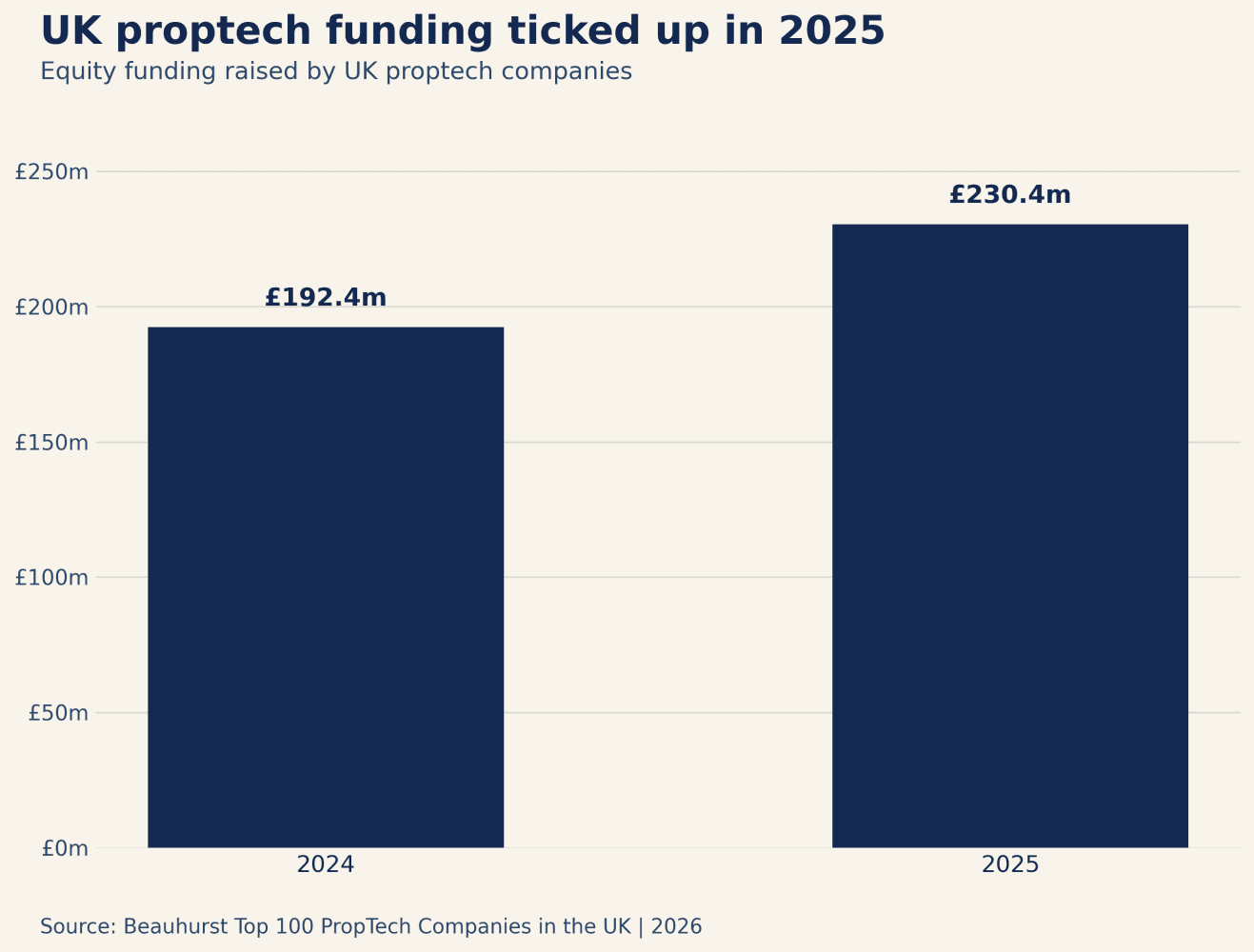
The cleanest chart this month may be Beauhurst’s update on UK proptech: the sector raised £230.4m in equity funding in 2025 versus £192.4m in 2024, while total lifetime UK proptech equity funding now stands at £3.05bn.
So what? The UK market is still growing, but the funding pool remains narrow and selective. This is a better backdrop than last year, but not an easy one - which is exactly why platforms need to show sharper ROI and differentiation.
Source: Beauhurst Top 100 PropTech Companies in the UK | 2026 - beauhurst.com
5) Number of the Month
£1.5bn - the size of the Competition Appeal Tribunal lawsuit filed against Rightmove over alleged excessive and unfair subscription fees charged to estate agents and developers.
So what? Whatever the legal outcome, portal economics are no longer just a gripe from agents - they are now a live regulatory and competition issue. That has implications for marketplace pricing power, agent dependence on dominant portals, and the value of alternative distribution models. reuters.com · catribunal.org.uk
6) Operator Play of the Month
Outcome-led proptech adoption. The clearest operating signal in April is that real estate buyers are becoming more ROI-literate and more selective about implementation. Whether you look at the practical themes in the 2026 ROI playbooks or the way AI-native platforms like Conxai are being funded, the emphasis is increasingly on systems that automate real work rather than decorate reporting.
So what? The operator edge in 2026 will come less from having “an AI strategy” and more from adopting fewer tools that measurably improve service levels, staff productivity, asset performance and delivery certainty. coradvisors.net · coradvisors.net · proptechconnect.com
7) Policy & Regulation Radar
Rightmove’s £1.5bn Competition Appeal Tribunal case is the most material UK proptech regulatory story of the month: the claim alleges that Britain’s dominant property portal abused its market position by charging excessive subscription fees, and Reuters reported the shares fell nearly 9% on the news. So what? Pricing power, marketplace dominance and the economics of digital distribution are increasingly becoming policy and competition questions, not just commercial ones. reuters.com · catribunal.org.uk
Digital planning still looks like one of the highest-potential policy-adjacent proptech themes, with the English Digital Planning Programme continuing to back local-authority tooling and structured planning workflows. So what? As planning data standards improve, the opportunity shifts from one-off pilot projects toward reusable infrastructure that can plug into live local-authority processes. localdigital.gov.uk · localdigital.gov.uk
Geovation’s 22nd accelerator cohort and the still-open digital planning funding window underline that public-sector-backed property and location innovation remains active in the UK ecosystem. So what? Planning, land and geospatial intelligence remain one of the most credible problem-solution fits in UK proptech - especially while official housing pipeline data is lagging. ordnancesurvey.co.uk · localdigital.gov.uk
8) Deep Dives on Hot Topics
Proptech × Fintech Intersect
Citi SPRINT’s clearest message was that capital is abundant; trust is scarce. The differentiators now are governance, structure, transparency and asset quality, not just origination growth. So what? The next phase of fintech lending will reward platforms that combine customer experience and differentiated origination with institutional-grade controls and durable funding relationships. linkedin.com · apgcapitalmarkets.com
The MFS / Century aftershocks continue to influence capital providers’ behaviour even without a fresh collapse in April. So what? Reporting quality, auditability and governance are becoming more important drivers of funding-line access and cost than they were in the easy-money phase. apgcapitalmarkets.com · linkedin.com
Real/REMAX and Rocket/Redfin underline the same broader point from a different angle: distribution, customer ownership and financing attachment remain hugely valuable. So what? The most resilient business models still sit where technology, customer journey control and capital flows intersect. investors.remaxholdings.com · ir.rocketcompanies.com
AI in Real Estate
Conxai is a strong example of where AI capital is still willing to go: construction remains fragmented, data-poor and operationally messy, which is exactly why a domain-trained, agentic system can look valuable to investors. So what? Vertical AI with deep workflow relevance still has plenty of room to win in the built environment. proptechconnect.com · finsmes.com
The “real-world AI” story is widening well beyond software: Reuters’ powered-land reporting and the market’s continued focus on data-centre infrastructure both point to the same conclusion. So what? The biggest AI opportunities in real estate increasingly sit where digital intelligence meets physical constraints - power, land, planning, grid access and delivery. reuters.com · cbre.co.uk · colliers.com
For a wider strategic lens, recent thought pieces from CORA Advisors and MRI argue that the market is separating meaningful AI and unified systems from fragmented, superficial tools. So what? That split will define who captures ROI in 2026: platforms that unify data and improve decisions across portfolios will keep compounding advantage; disconnected point products will find it harder to survive procurement scrutiny. coradvisors.net · mrisoftware.com
Public-sector innovation support is still feeding the ecosystem: Geovation’s new cohort, combining location intelligence, land and property data with AI, automation and remote sensing, is a reminder that some of the most useful built-environment innovation still sits at the junction of public data and private tooling. So what? AI in the built environment is not just a private-market story; it also depends on the quality and accessibility of underlying public data and infrastructure. ordnancesurvey.co.uk
9) Events
UKREiiF, Leeds, 19-21 May 2026 - ukreiif.com
London Tech Week, London, 8–12 June 2026 - londontechweek.com
Real Estate:UK Annual Conference 2026, London, 7 July 2026 - ukproptech.com
PropTech Connect Europe, London, 9-10 Sep 2026 - proptechconnect.com
UK Events Programme: UK PropTech Association (UKPA) Events - ukproptech.com
Global events calendar – PropTechVision: proptechvision.com
10) Further Reading
6 PropTech Trends Driving Real Estate ROI in 2026.So what? A practical ROI-oriented checklist covering the categories buyers are finding easiest to justify in 2026. coradvisors.net
Investor Views on PropTech Adoption in 2026: ROI, Risks, and Returns. So what? A useful companion piece on how investors are thinking about proptech as a returns driver rather than an add-on. coradvisors.net
State of the Market - April 2026 (CrowdProperty). So what? A concise read on mortgage repricing, build costs, refinance pressure and planning delays. crowdproperty.com
Housing Market Update - April 2026 (Savills). So what? A clean summary of how improved Q1 momentum is now meeting renewed mortgage-rate caution. savills.co.uk
UK Housing Market Forecast: Q2 2026 (Knight Frank). So what? A useful read-through from geopolitics and mortgage rates into the near-term housing outlook. knightfrank.co.uk
Top 100 PropTech Companies in the UK | 2026 (Beauhurst). So what? Useful for framing how concentrated UK proptech funding remains and which clusters/stages dominate the market. beauhurst.com
Geovation marks ten years of the Accelerator Programme with the launch of its 22nd cohort. So what? A useful reminder that location, land and property data innovation remains active and institutionally supported in the UK. ordnancesurvey.co.uk
2026 Commercial Real Estate Trends (J.P. Morgan). So what? Helpful macro anchor on where capital and operating conditions are improving – and where they remain uneven. jpmorgan.com
For UK residential property market insights, subscribe to the CrowdProperty UK newsletter - linkedin.com
For Australian residential property market insights, subscribe to the CrowdProperty Australia newsletter - linkedin.com
Mike Bristow
Founder of Growth Strategy. Operator, advisor and investor across strategy, capital, M&A and board roles.
About Mike
More perspectives
Strategy & Growth
Make sharper choices, build sustainable advantage and turn strategic intent into measurable enterprise value.
Capital
Secure and optimise the institutional capital required to lend, invest, acquire, build or scale.
M&A & Transactions
Prepare, position and execute acquisitions, disposals, liquidity events and strategic partnerships.
Board & Executive
Add experienced judgement, challenge and execution capacity at board and executive level.