Proptech Briefing
1) Key Takeaways
Help to Buy is back, rebuilt for first-time buyers and part-funded by developers: on 26 September the government announced Your First Home, a new-build equity loan scheme for England: a 2.5% deposit, a 20% government-backed equity loan with an initial interest-free period, household income caps, local price caps and a contribution from participating developers. Prime Minister Andy Burnham made the announcement, and the Chancellor will set out costs and timings at the Budget on 28 October. Housebuilder shares jumped on Monday, with Persimmon up around 15%, Barratt Redrow, Bellway and Taylor Wimpey around 12% and Vistry around 10%. So what? The government has reached for the lever that moves sales rates fastest, not the one that fixes viability. It will lift absorption on sites already open long before it opens new ones, and it arrives just as mortgage rates turn up. The detail due on 28 October, above all how the scheme ends, will decide whether this is a bridge or a dependency. See the deep dive below. gov.uk · expressandstar.com · rossmartin.co.uk
The rate cycle has turned, and the Bank is now debating when to raise: the MPC held Bank Rate at 3.75% on 17 September, but all three dissenters (Greene, Mann and Pill) voted to raise it to 4.0%. CPI rose to 3.1% in August, the Bank expects inflation slightly above 4% early next year as energy costs feed through, and the market curve now peaks at around 4.9% by the end of 2027. Average five-year fixed mortgage rates reached 5.96% by late September, the highest since October 2023. So what? Three months ago the debate was the pace of cuts; now it is the timing of rises, and every appraisal with a 2027 exit is carrying that change whether its authors have repriced it or not. For first-time buyers the barrier has shifted from the deposit to the monthly payment, which a deposit scheme only partly solves. bankofengland.co.uk · ons.gov.uk · hoa.org.uk
Dubai up close, from a week on the ground: fifteen or so conversations across Dubai and Abu Dhabi, from pre-revenue founders to a regulated tokenisation business, digital mortgage operators, family offices and portal executives. The headline conclusion is that almost everything interesting in the region’s proptech is a financial services product, built on a market that is largely cash, pays rent in advance and has several hundred thousand off-plan units still to hand over. So what? The fastest-scaling businesses there are capital markets businesses wearing proptech clothes, and they will be valued, funded and eventually tested as lenders. The UK has a lot to learn from Dubai’s regulator and registry; Dubai has a lot to learn from the UK’s failures. See the special deep dive below. gulfnews.com · wamda.com
PropTech Connect Europe marked the shift from “adopt AI” to “prove it”: the programme at London’s InterContinental O2 on 9–10 September was built around AI and data for asset performance, adoption at scale, retrofit, repositioning and the high-growth sectors of logistics and data centres, with the National Housing Bank’s chief executive among the headline speakers. The tone reported since is markedly more sceptical than a year ago: less about whether to adopt AI, more about where it earns its keep, what risk it introduces and where human judgement stays in charge. So what? The weeks either side supplied the evidence: agentic start-ups absorbed into platforms, open proptech job postings down nearly 59% in about three months, and pricing moving from seats to outcomes. See AI in Real Estate below. proptechconnect.com · tracesolutions.co.uk · inman.com
Incumbents are paying for data layers, not features: Schneider Electric agreed a €1.2bn public takeover of smart-building device maker Shelly at a 27% premium, Procore closed its $845m cash acquisition of drone-imagery platform DroneDeploy, Venn bought agentic leasing business Zuma for $50m, and WSP walked away from a €4.4bn approach for Arcadis after two proposals were rejected. So what? Strategic buyers are paying premiums for installed bases and proprietary operating data their AI can run on. WSP’s retreat shows the limit: scale in a people business is harder to buy than a data asset. For founders, the question before the next round is which incumbent’s data model you complete, and whether that makes you a partner or a target. globalbankingandfinance.com · constructiondive.com · constructionenquirer.com
2) VC/PE Investment Activity
Veridue raises $4m pre-seed for AI due diligence on energy and data-centre assets: Episode 1 Ventures led, with High-Tech Gründerfonds and Pi Labs participating alongside angels Cameron Hepburn (co-founder of Aurora Energy Research) and Jeremy Palmer (former CEO of QuantumBlack). London-based Veridue automates the diligence behind renewables and data-centre investment, from origination and screening to data rooms, Q&A and investment committee papers, work that typically takes weeks. Founder and chief executive Daniel Csonth, a former McKinsey energy investment adviser, brings more than $10bn of energy M&A experience, and the company was one of five selected for Pi Labs’ agentic AI growth programme in May. So what? Grid queues, hybrid projects and changing revenue models are making every energy asset slower to assess, and slow diligence is a hidden cost of capital. The moat, if it holds, is Veridue’s proprietary dataset of real deals and their diligence outcomes rather than the model on top, the same data-layer logic behind this month’s larger deals. The test is whether investors, lenders and insurers let an agent’s output into the credit file. (Disclosure: I am a Pi Labs Venture Partner and Investment Committee member.) veridue.ai · tech.eu
Buildots raises $130m as construction AI follows data-centre capex: O.G. Venture Partners led, with Lightspeed, Intel Capital, Qumra, Viola Growth and Poalim Equity, taking total funding to $297m. Buildots, which compares site progress against plan using computer vision, now has 100+ large construction customers, roughly double the number sixteen months ago, and is positioning explicitly around the global data-centre build-out. So what? The largest construction AI rounds are now justified by hyperscaler programmes rather than housing, because that is where overruns are most expensive and owners most willing to pay for evidence. Progress data that owners trust becomes the basis for payment, disputes and insurance, a far larger prize than a dashboard. siliconangle.com · prnewswire.com
Schneider Electric agrees a €1.2bn takeover of Shelly Group: the voluntary public offer is €70 a share, a 27% premium to the late-July reference price, with founders holding around 57% conditionally committed and completion expected in Q1 2027. Sofia-based Shelly makes smart-home and small-building IoT and energy-management devices, and has grown revenue by more than 40% a year since 2022. So what? Schneider is buying an installed base, and the consumption data it produces, in homes and small buildings its own channels have never reached. As energy management moves down to the individual dwelling and the small commercial unit, the installed base is the distribution. globalbankingandfinance.com · proptechconnect.com
Procore completes its $845m cash acquisition of DroneDeploy: the deal closed on 9 September, combining Procore’s project records (around 400m photos and 126m+ drawings) with DroneDeploy’s visual record of 20 trillion square feet of sites, and DroneDeploy, now part of Procore, has since launched Ground Pro for 3D reality capture. So what? Last month CoStar paid cash for Zonda’s data on homes not yet built; this month the leading construction platform paid cash for the visual record of sites being built. The pattern is consistent: platforms are buying the ground truth their AI needs rather than waiting for customers to create it, and a standalone reality-capture business now has fewer independent futures. tradingview.com · constructiondive.com
Debt funds the asset, equity funds the product: Saudi rent-now-pay-later platform Rize secured a SAR187.5m ($50m) asset-backed Murabaha facility from Jadwa Investment to finance its portfolio of rental contracts (more than 200,000 tenants have used the platform); Riyadh building-materials marketplace BRKZ raised $31m, of which $18m is growth debt from Stride Ventures alongside $13m of Series B equity co-led by Aramco’s Wa’ed Ventures and 500 Global; and in the UK, Sixth Street signed a co-operative agreement with Lloyds to provide funding to commercial real estate borrowers. So what? Embedded-finance proptechs are learning to keep receivables off the equity line, which is right: equity at venture cost should never fund a loan book. The discipline that follows is the one set out in the Dubai deep dive below, because a company funding its assets with debt is valued, and tested, as a lender. wamda.com · globenewswire.com · sixthstreet.com
PropTech Connect’s September flow shows the breadth beneath the headline deals: Reapit took £20m+ from Accel-KKR, Trebellar raised an $18m Series A led by London’s Blossom Capital for corporate real estate portfolio software, Mainstay raised $18m and acquired AI listings platform Truelist, Reframe Systems raised $40m for robotic housing microfactories, syte raised €9m for AI land assessment in Germany and Metris raised $5m to build a data layer for energy assets. Elsewhere, Perry Weather raised a $110m Series C for site weather safety, Adaptive $30m for agentic construction accounting, Scaffold a $15m seed with D.R. Horton, PulteGroup and Builders FirstSource as strategic investors, and UK mortgage app Sprive a £7.7m Series A. On the exit side, SmartCraft bought Dublin-based contech LiveCosts at roughly 4.8 times ARR including earn-out, and 20VC-backed London marketplace Ostrich shut down. Crunchbase counts $8.7bn of proptech venture funding across 794 deals in 2026 to date, against $12.3bn for the whole of 2025. So what? Customers are becoming shareholders at seed, Nordic acquirers are pricing UK and Irish growth businesses at software rather than venture multiples, and the month’s most consequential activity was acquisitions, not rounds. proptechconnect.com · proptechconnect.com · bricks-bytes.com · bricks-bytes.com · bricks-bytes.com · fintech.global · tech.eu · news.crunchbase.com
3) Market Insights
Prices have tipped into annual decline on one measure: the Lloyds House Price Index put the average UK home at £298,468 in August, down 0.2% on the month and 0.4% on the year, the first annual fall since November 2023. Northern Ireland hit a record high on 6.9% growth while London fell 1.5% and the South East 1.6%. Nationwide, on a different basis, still shows 1.6% annual growth, and Rightmove reports stock for sale at a 12-year high for the time of year. So what? High stock, flat-to-falling prices and rising mortgage rates make this a buyer’s market in all but name. That is the backdrop against which a new-build equity loan will be judged: good timing for the state as a buyer of equity, harder timing for a first-time buyer who needs the home to hold its value. lloydsbank.com · nationwide.co.uk · rightmove.co.uk
Mortgage pricing is moving faster than Bank Rate: Moneyfacts’ average two-year fix reached around 5.92% and the five-year 5.96% by late September, up from 5.52% and 5.64% at the start of the month, the highest five-year average since October 2023. Mortgage approvals for house purchase fell to 56,100 in July and the effective rate on new mortgages rose to 4.45%. So what? The Bank has not moved, but the market has priced its next moves, and borrowers pay the market. With around 900,000 fixed deals maturing in the second half of this year, the payment shock is arriving in the existing owner-occupier stock as well as at the point of purchase. hoa.org.uk · bankofengland.co.uk · mortgagesolutions.co.uk
Construction is contracting again, and housing is leading it down: the S&P Global UK Construction PMI slipped to 44.3 in August, the twentieth consecutive month of contraction, with housebuilding at 37.6; ONS data show private housing new work down 4.9% in July; and construction accounted for 3,866 company insolvencies in England and Wales in the year to August, 17% of the total and more than any other sector. CrowdProperty’s September State of the Market adds that materials prices for new housing were 4.9% higher year on year in July, and that respondents to a poll by The Intermediary rank build costs (38%) ahead of planning (35%) and demand (25%) as the main barrier to delivery. So what? July’s “less bad” did not last. The industry is telling its lenders that cost, not consent, is the binding constraint, and cost is the constraint Your First Home does least to address. pbctoday.co.uk · ons.gov.uk · crowdproperty.com · gov.uk
Starts look better than they are, and the pipeline behind them is thin: MHCLG’s indicators show seasonally adjusted starts in England up 20% year on year to 35,910 in Q2, but a change in Building Safety Regulator reporting added 5,758 of them, and rolling annual completions are flat at 143,770. The Home Builders Federation counts just 1,220 private sites granted permission in Q1, the lowest since its series began in 2006. So what? Strip out the reporting change and starts are roughly flat year on year. Fewer permitted sites today means fewer sales outlets in 2028, whatever demand support arrives in between. gov.uk · hbf.co.uk
Rents are re-accelerating as rental supply tightens: ONS puts average UK private rents at £1,400 in August, up 3.8% on the year; Zoopla reports rental supply down 3%, its first fall in three years, with 5.3 enquiries per listing; and RICS surveyors’ three-month rent expectations jumped to a net balance of +44 from +33. Pegasus Insights finds 22% of landlords sold property in the year to June, against 38% who had said they intended to. So what? The Renters’ Rights Act exodus is smaller than feared but large enough to tighten supply, and rising rents strengthen the case for ownership just as ownership gets harder to finance. Anyone who can convert rent into equity efficiently is addressing a growing market (see the Your First Home deep dive below). ons.gov.uk · rics.org · thenegotiator.co.uk · landlordzone.co.uk
4) Chart of the Month
The Cliff Behind the Comeback.
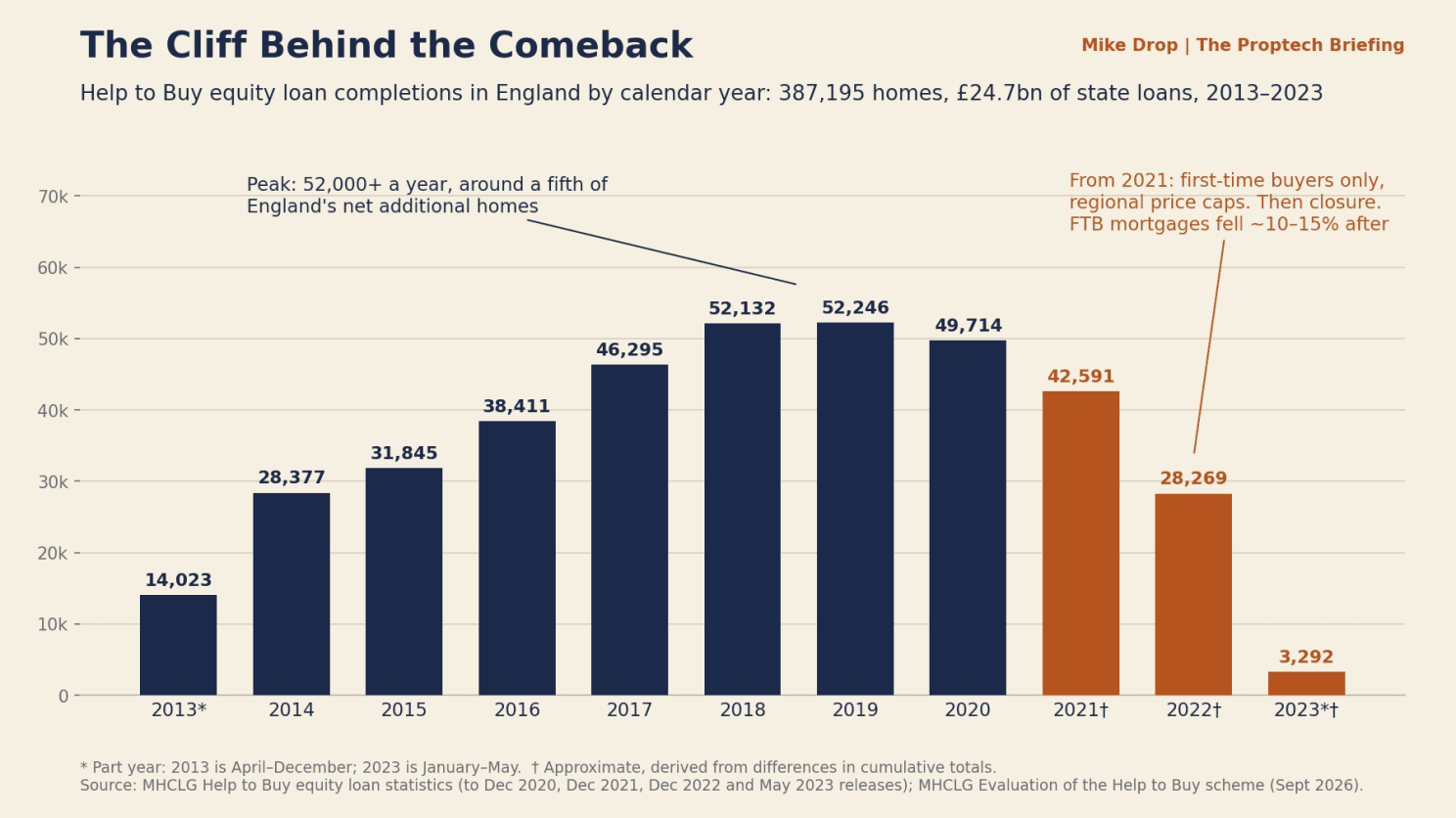
Help to Buy’s equity loan financed 387,195 home purchases in England between April 2013 and May 2023: £24.7bn of state loans supporting £109.2bn of property. Completions climbed every year to a peak of more than 52,000 in 2018 and 2019, equivalent to around a fifth of England’s net additional homes in those years, then fell away as the scheme was restricted to first-time buyers with regional price caps from 2021 and closed in 2023. The government’s own evaluation, published in mid-September, found first-time buyer mortgages fell by around 10–15% after it closed.
So what? This chart is the argument for designing Your First Home’s exit before its entry. A scheme that underwrites a fifth of new supply stops being support and becomes part of the business model: in 2018 the five developers making most use of it sold between 36% and 48% of their homes through it. Income caps, price caps and a developer contribution are better targeting than last time. The question for 28 October is whether there is a published taper, because the last cliff was visible years in advance and the industry still built its pipeline to the edge of it.
Source: MHCLG Help to Buy equity loan statistics (2021–2023 derived from cumulative totals; 2013 is April–December, 2023 is January–May); MHCLG Evaluation of the Help to Buy scheme (September 2026); Public Accounts Committee (2019). See Further Reading for full sourcing.
5) Number of the Month
22.6% – the share of gross income the typical UK first-time buyer was spending on mortgage payments in June 2026, according to UK Finance, the highest at any point since the global financial crisis. Fixed mortgage rates have risen further since.
So what? Your First Home attacks the deposit; this number says the monthly payment is at least as binding. The scheme does help here, because a 77.5% loan-to-value mortgage prices materially better than a 95% one and the equity loan is interest-free at first, but that saving is time-limited. The real test is the payment on the day the interest-free period ends, at whatever rates prevail then. Lenders’ affordability models will price that date, and buyers should too.
ukfinance.org.uk · mortgagesolutions.co.uk
6) Operator Play of the Month
Give the software away, charge for the outcome. Venn, which describes itself as a sovereign AI platform for real estate, paid $50m for Zuma, whose agents handle multifamily leasing, renewals and collections. Its pricing logic is explicit: “We give the software away. What you pay us for is the intelligence platform… and the agentic outcomes.” Venn serves 270+ owners and operators, expects to pass a million units by the end of the year, and says its agents have cut human escalations by nearly 60%.
So what? Per-seat pricing breaks when the agent replaces the seat. Operators buying AI should now negotiate on leases signed, arrears collected and escalations avoided rather than on licences, and should insist the data model stays theirs. For UK letting agents facing the Renters’ Rights Act’s new database and dispute regime, an outcome-priced agent is a cost line that falls when performance falls, which is a far easier Board conversation than another software subscription.
proptechconnect.com · calcalistech.com
7) Policy & Regulation Radar
Renters’ Rights Act phase two now has dates and a price: registration on the new private rented sector database opens on 15 December in the West Midlands and rolls out region by region to a national deadline of 14 November 2027, at £65 per property per year, with gas, electrical and EPC certificates uploaded and penalties of up to £7,000, or £40,000 for repeat breaches or false information. Rent disputes will move from the tribunal to the Valuation Office Agency on a date yet to be set. So what? England is about to get its first national, compliance-linked register of rented homes. For letting and compliance software it is a data spine and a deadline; for the smallest landlords it is another reason to sell or hand over to an agent. It also begins, slowly, to close the rental data gap with Dubai described below. osborneclarke.com · bateswells.co.uk
The Nature Restoration Levy is live: the Nature Restoration Levy Regulations 2026 were made on 10 September and came into force the next day, requiring planning authorities to impose a condition that development cannot start until the levy, or its first instalment, has been paid. So what? It converts ecological obligations that stalled sites for years into a priced cash cost. That unblocks land, but the cost lands in the land residual and is payable before the first spade, so SME developers with thin working capital will feel it first. legislation.gov.uk · planningjungle.com
Gateway 2 has unblocked just as the Building Safety Levy lands: Building Safety Regulator data show new-build approval rates at 92%, from 39% a year earlier, and median decision times of 22 weeks, down from 43. Applications surged in August ahead of the Building Safety Levy, which starts on 1 October. So what? The biggest process blocker on high-rise residential is easing just as a new per-unit tax arrives. For build-to-rent and tall schemes, programme risk falls and cost rises; lenders should re-run both lines rather than assume they cancel out. assets.publishing.service.gov.uk · constructionenquirer.com
The EU proposes its first binding housing law: the Affordable Housing Act, published on 9 September as a directly applicable regulation, defines “areas under housing stress” mainly by a price-to-income ratio of eight or more, lets authorities restrict commercial-scale short-term letting on three years of evidence, and arrives alongside revised state-aid rules for social and affordable housing. So what? Short-let operators in Europe’s most expensive cities will face a common legal test rather than a patchwork of municipal rules. That is worse for aggressive operators and better for compliant ones with the data to prove their case. luxembourg.representation.ec.europa.eu · housing.ec.europa.eu
8) Deep Dives on Hot Topics: Two special deep dives this month
Special: Your First Home. Why a new Help to Buy is needed, where it is weak, and who it really helps
Announced on 26 September, Your First Home is an equity loan scheme for first-time buyers of new-build homes in England. The buyer puts down 2.5%, the government lends 20% as an equity loan with an initial interest-free period, and a mortgage covers the remaining 77.5%. On a £230,000 starter home, that is a £5,750 deposit and a £46,000 equity loan. Eligibility will be limited by household income caps and local price caps, only developers who sign up and contribute to the cost can offer it, and the numbers, cost and timetable arrive with the Budget on 28 October. Against the original Help to Buy it halves the deposit and adds income tests and a developer contribution. Against Freedom to Buy, the permanent mortgage guarantee that works through lenders on any home up to £600,000, it is narrower but puts state equity, rather than a guarantee, into the deal.
The case for something is strong. First-time buyers were spending 22.6% of gross income on mortgage payments in June, the highest since the financial crisis, and fixed rates have risen since. New-build sales are weak: Barratt Redrow has cut its guidance for the year to June 2027 to 17,500–17,900 completions, blaming planning delays for fewer sales outlets; Rightmove says the number of new developments coming to market has fallen to its lowest rate on record; and HBF counts the fewest private housing sites permitted in a quarter since its records began in 2006. The evidence on the original scheme is also better than its reputation. The government’s evaluation, published eleven days before the announcement, estimates a net present social value of £25.1bn, attributes around 15% of new builds in 2013–2023 to the scheme, and finds positive effects on developer revenues and margins, particularly for SME builders. Savills’ Lucian Cook put the argument most sharply: without intervention, the industry risked permanently losing capacity.
The same evaluation carries the case against. 54% of buyers said they could have bought a suitable home without it; prices rose in areas that were already expensive; new builds carried a 5–6% premium, with around 1% more on Help to Buy homes; and the second phase from 2021, in a stronger market, achieved much less. The Public Accounts Committee concluded in 2019 that around three-fifths of buyers did not need the scheme. The Centre for Policy Studies argues the new version “will subsidise demand for housing while doing little to address underlying issues”, and resale value is the quieter risk: today’s subsidised new build becomes tomorrow’s second-hand home without the subsidy behind it. Most importantly, the scheme addresses the deposit and part of the payment, but none of build cost, the Nature Restoration Levy, the Building Safety Levy or the rising exit rate that run through the rest of this edition.
Market consensus is a welcome with conditions. The Home Builders Federation wants it implemented quickly; Savills, Knight Frank, Rightmove, NatWest and the Intermediary Mortgage Lenders Association are supportive; RBC called it “Christmas come early” for housebuilders. The reservations are all about design: the length of the interest-free period, the level of the caps, and whether the developer contribution is absorbed in margin or quietly added to prices. The equity market has already voted on who benefits: volume builders most exposed to first-time buyers rose by 12–15% on Monday morning, even though Panmure Liberum expects the scheme to take a couple of years to properly stimulate the market.
For the UK’s rent-to-own, shared-equity and deposit-bridging propositions, I have not yet seen public comment, but the implications are clear enough. On new-build, a state equity loan that is interest-free at first beats any private equity-share or rent-to-buy offer on price, so private deposit-bridging for new-build first-time buyers will be crowded out for as long as the scheme runs. The defensible ground is everything the scheme excludes: second-hand homes, which are most of the market; buyers above the income and price caps, which in London and the South East may be most buyers; and households with no deposit at all, the core rent-to-own customer. There is also a new opportunity. The evaluation criticises the old scheme’s redemption process for short valuation windows and poor communication, and every equity loan that reaches the end of its interest-free period will need valuation, staircasing and often refinancing, including into long-term fixed-rate mortgages. That is a servicing and refinance market that did not exist a month ago.
Applying the operator, investor, Chair and capital lenses together: operators, especially SME developers, should push early for simple participation terms, because the evaluation found the original scheme particularly helped smaller builders, and a heavy administrative burden plus a levy would hand that advantage straight to the volume builders. Investors should read Monday’s share moves as a view on 2027 absorption rates, not on starts, and underwrite accordingly. Boards of rent-to-own and equity-share businesses should re-segment their target market around the caps the day they are published. Capital providers should note what the mortgage lender now sees: a 77.5% first charge in place of a 95% one, with the state holding the next slice, which means lower capital consumption and a better credit. From a lender’s seat, the most valuable effect may be the one Huspy is selling to developers in Dubai: a housebuilder that knows its buyer is financeable a year before completion has de-risked its own receivable. Your First Home does that for UK housebuilders, and that is worth more to them than the headline sales uplift.
gov.uk · gov.uk · hbf.co.uk · propertyindustryeye.com · estateagenttoday.co.uk · mpamag.com · proactiveinvestors.co.uk · uk.finance.yahoo.com · propertyindustryeye.com · publications.parliament.uk · financialreporter.co.uk
Special Deep-Deep Dive: Dubai up close. Where it is ahead, where it is catching up, and the one model that will not survive the cycle
A proper deep dive this month, written from a week on the ground. It runs longer than our usual specials, deliberately.
Last month I noted that BCG’s inaugural Intelligent Cities Index put London first and Dubai second, and that Dubai was where I would be in mid-September. I have now spent that week there, with time in Abu Dhabi, across fifteen or so conversations chosen deliberately to cut across the whole stack rather than one slice of it.
That meant pre-revenue founders with a working product and no pricing model yet; venture-backed platforms financing rent, guarantees and handover payments; a regulated tokenisation business weeks away from listing its first assets; profitable bootstrapped software businesses; digital mortgage operators running across more than one country; agency software incumbents fighting AI-native entrants; commercial leasing and visualisation businesses; family offices and a European venture fund deploying into the region; developer and portal executives; and mentoring sessions plus a Proptech Elevate fireside across the Dubai Proptech Hub cohort at DIFC Innovation Hub.
One caveat worth stating plainly, because it is the first thing anyone who works here will think. Dubai is a relationship market that reveals itself in layers, and a week gets you through only the outer few, however good the line-up. What follows is what an exceptional set of meetings supports, not a claim to have seen the whole onion.
The centre of gravity is the proptech and fintech intersect, and it is structural rather than fashionable
Almost everything interesting in Dubai proptech right now is a financial services product. That follows directly from how the market is built. Roughly four fifths of transactions are cash. The overwhelming majority of tenants pay rent annually or quarterly in advance, historically by post-dated cheque. Banks are capped on aggregate real estate exposure, which locks tier-two developers out of completion capital even when their units are sold and the money is sitting in escrow at the Land Department. Mortgage penetration is low against several hundred thousand off-plan units due to hand over through the rest of the decade, where the handover payment alone is typically 30% to 40% of value.
None of those are software problems. They are problems of capital provision, capital phasing, capital allocation and risk transfer, and each is now being attacked by a venture-backed business: rent factoring and monthly rent rails, guarantees that make rental income underwritable, handover and completion finance, developer bridge lending, fractional and tokenised ownership, and mortgage distribution embedded in the developer’s own handover process, which readers will recognise from last month’s note.
So what? The fastest-scaling businesses here are capital markets businesses wearing proptech clothes, and that changes what determines success. Not the product roadmap but cost of capital, funding line diversity and concentration, credit policy when growth targets start pushing against it, and the consequences of pricing, liquidity and governance decisions that bite years after they are taken. It also changes the multiple. Take credit risk onto your own book and you will be valued as a lender, not a platform, however good the app is.
One further point that is rarely made and matters enormously. The dirham is pegged to the dollar, so the cost of capital for every one of these lenders is set by the Federal Reserve, while demand for the underlying assets is driven by regional and global flows into Dubai. Funding cost and asset demand are therefore set by different masters and can move apart sharply. Any model that assumes they move together is carrying an unhedged basis risk that nobody has named.
The provocation: capital appreciation is not a business model
Here is the thing I would say to every founder in this market, and to a fair number of their investors.
If your returns depend on property prices rising, you do not have a business. You have an operationally complex spread bet on an index, wrapped in a cap table, a licence, a payroll and a customer support function. Your investors could take the same exposure directly, with more liquidity, lower cost and none of the execution risk. So could you, and without the eighty-hour weeks.
This matters more here than almost anywhere because the entire operating history of this cohort sits inside a single extraordinary upswing. Yields were compressed by appreciation, exits were flattered by it, and cost of capital was cheap relative to the growth it funded. Strip appreciation out and what remains has to be income, spread, fee or data. If nothing remains, that is the answer.
The discipline this demands is unglamorous. Model the direct effects through a genuine down case: values off 20% to 25%, transaction volumes halved for eighteen months, occupancy softening and rents flat or falling. Then the second order effects, which are where most of the damage actually sits. Falling values change loan-to-value on the book you already wrote. Softer rents change affordability and therefore default behaviour. Slower transactions change the velocity that your fee income depends on and lengthen every funding line’s duration assumption. Then the third order effects, which almost nobody models. A wave of defaults changes what your insurer will underwrite and at what price, or what your funding partner will advance against. Losses at scale change the credit box you can offer, which changes who you can serve, which changes your acquisition economics and your growth story at precisely the moment you need to raise. A public secondary market with widening discounts becomes a price signal that your competitors, your press and your investors read weekly.
Isolating the model from direction of travel is the work. That means income that is contracted rather than expected, risk that is priced and transferred rather than absorbed by default, funding that is diversified across counterparties and durations, and governance and liquidity policies written for the bad year rather than the good one. A business built that way compounds through a cycle. A business built on the market going up compounds only until it does not.
Where Dubai is genuinely ahead of the UK
The regulator moves at the speed of a product team. The Dubai Land Department has made tokenisation live rather than theoretical, partnering with PRYPCO Mint on what is described as the first tokenisation of property title deeds with a government registry. Its pilot drew more than AED 18.5m from investors of over 50 nationalities between May 2025 and February 2026, PRYPCO Mint opened a regulated resale market on 20 February, and the stated ambition is AED 60bn of tokenised transactions, around 7% of the market, by 2033. VARA is now licensing broker-dealers, such as Tribe Tokenisation, to widen distribution of tokenised property. In the rental market, DLD launched Flexi Rent in June to normalise monthly payment, then announced a zero-interest Rent Now, Pay Later scheme with a partner bank from September. Policy to live product in months rather than parliaments is a real competitive advantage for a city, and it is the most underrated thing about this market.
Registry-grade data is public infrastructure. Granular, near real-time transaction and rental data, with tenancy registration through Ejari, is the foundation under the underwriting, valuation and pricing businesses I met. The UK has nothing comparable. Land Registry data lags and there is no rental register at all. Most UK proptech data businesses spend their first two years assembling what a Dubai founder can query on day one.
Distribution is concentrated and the portals behave like strategics. Two portal groups are effectively the rails of this market, and a partnership with one alters a company’s trajectory overnight. The sharpest structure I saw paid a portal’s revenue share in equity rather than cash, aligning both sides to a tenfold increase in listings. Rightmove and Zoopla do not do this.
Government is a customer as well as a rule-setter, with tens of thousands of units being moved onto digital rent payment rails through private platforms. No UK proptech is handed anchor demand at that scale.
Where it is catching up
Early-stage capital formation is the weakest link. Sovereign and mega-round money at one end, friends and family at the other, very little in between. That gap is compounded by a founder base that is overwhelmingly expatriate, and which left behind the network that writes the first cheque. In the UK that network is also state-subsidised, with SEIS putting £276m into 2,430 companies in 2024-25 and EIS £1.575bn into 3,735. There is no equivalent here, and local angels weigh a loss-making software business against roughly 7% yields on property. That is a competitive problem, not a founder education problem.
Credit infrastructure is thin. A transient population with short bureau histories forces underwriting onto alternative data, open banking and digital identity. The businesses doing this well are building a proprietary bureau as a by-product, which is the real asset and is being undervalued in their own pitches.
Retention is structurally harder. With around 10,000 agencies and 30,000 licensed brokers, and new agencies registering daily as others close, software churn runs at roughly double UK levels. Anyone underwriting this market on UK retention assumptions will be wrong.
The emirates are separate markets, not one. A licence in Dubai does not travel ninety minutes down the road, and registries, regulators and government counterparties differ. Expansion within the UAE is closer to international expansion than domestic rollout, and plans rarely price that in.
Nothing here has been tested through a sustained fall in values. This spring was a severe volume and sentiment shock, and I heard credible accounts of transactions halving and of one business losing the overwhelming majority of its revenue overnight before recovering half quickly. That is a resilience test worth having. It is not the same thing as a two-year decline in prices.
What happens when the state enters your market
The most instructive dynamic here is the zero-interest rent instalment scheme. A bank-funded, government-sponsored product at 0% will not take all the volume, because it will be rationed to prime salaried customers of the partner bank. What it does is reset the ceiling on what anyone can charge and quietly worsen the credit mix left in the private book, which is a second order effect that will not appear in anyone’s numbers for a year. The same logic runs through tokenisation, where the state owns the registry rail and the regulated secondary, so no independent platform can differentiate on the act of tokenising. It has to differentiate on origination and asset quality.
So what? Where the state moves this fast, the durable positions are building where it will not go, or becoming the origination, servicing and data layer on top of its rails. Fee income earned on someone else’s balance sheet, with the customer relationship held tightly, beats competing with a sovereign on price. UK founders should absorb that before the next wave of state-backed housing and lending infrastructure arrives here.
The institutional capital problem, and why guarantees matter more than they look
Dubai residential is almost entirely strata-titled, so there are no bulk buildings to buy and institutional capital of the Greystar type will not assemble twenty thousand units one at a time. Every serious platform I met has reached the same conclusion from a different direction: the route to institutional money is an operating platform that aggregates granular stock into a managed income portfolio, at three to four thousand units with management in house, then presents it as an asset rather than a collection of flats. Guarantees and rent factoring are what make that income contracted and predictable enough to underwrite. That is the missing infrastructure for institutional-scale UAE residential, and it is the same problem UK single-family rental solved with a different toolkit. Note the contrast with the UK, where build-to-rent starts fell 79% in the year to June while capital here is chasing a supply wave.
What each market should take from the other
For the UK: registry-grade transaction and rental data as public infrastructure, a regulator willing to set a target and a date rather than consult indefinitely, guarantee and insurance wrappers that make granular income institutional, and portal partnerships structured in equity rather than referral fees.
For Dubai: our failures are the syllabus. UK digital mortgage brokers proved the product and died on unit economics, because a proc fee of 0.35% to 0.6% never covered the cost of a completed case, and not one exited to a technology buyer. Habito went to Monzo in April, Trussle to Better and then to OneDome, Mojo to RVU, each ending up owned by someone who already had the customer. Our marketplace lenders learned that platforms die slowly through asset quality rather than quickly through technology. Our fractional platforms learned that exit-vote thresholds and liquidity policies written in year one determine whether investors are still there in year five, and that a discount is not the same thing as a bid. Dubai’s economics are better, particularly on mortgage commission. The failure modes travel regardless.
Applying the operator, investor, Chair and capital lenses together: operators should decide explicitly whether they are an insurance distribution business, a data business or a capital markets business, because that answer sets the metrics, the hires and the multiple, and drift between the three is the most common cause of a stalled Series B. Investors should diligence most UAE proptech as credit, starting with funding line concentration, static-pool loss curves by vintage, and whether distribution incentives are pulling against underwriting quality. Boards should require a written down-case with second and third order effects traced through insurer appetite, funding availability and credit box, alongside a stress test of a state-backed alternative landing at zero cost, because in this market that is a live scenario rather than a tail risk. Capital providers should recognise that the aggregation platforms here are assembling exactly the contracted, underwritable granular income institutional money has been unable to access in this market, and that the first into forward-flow structures will get the best terms of the cycle.
dubailand.gov.ae · zawya.com · tahawultech.com · gulfnews.com · wamda.com · wamda.com · menabytes.com · gov.uk
Proptech × Fintech Intersect
Bridging is shrinking while clean collateral still prices well: the Bridging and Development Lenders Association’s Q2 figures show applications down 26.3% on the quarter to £7.3bn, completions down 15.2% to £1.6bn and the loan book down 10.6% to £10.3bn. In the same week LendInvest priced Mortimer 2026-1, its first UK STS securitisation, a £300m prime buy-to-let deal (a £265m portfolio plus pre-funding) whose AAA Class A notes priced at SONIA plus 82 basis points and were 2.5 times oversubscribed, and Market Financial Solutions’ founder filed a defence denying the £1.267bn misappropriation claim against him. So what? This is the dispersion August’s note on private credit anticipated. Capital has not left specialist property lending; it has moved to lenders whose collateral, controls and data survive a securitisation investor’s diligence. New verification tools such as Underwriting UK’s W.A.L.T. platform, launched this month, exist because the MFS collapse showed what weak asset verification costs. bridgingandcommercial.co.uk · theintermediary.co.uk · bridgingandcommercial.co.uk · bridgingandcommercial.co.uk
Banks and private credit are splitting the lending stack between them: Sixth Street’s co-operative agreement with Lloyds covers funding for UK commercial real estate borrowers, with size and mechanics undisclosed. The same manager formed a joint venture with Figure that bought loans from the balance sheet of Kiavi, the US transition lender whose acquisition by Figure completed on 3 September, and in the US, Berkshire Residential took full ownership of multifamily lender MF1, which has originated $32bn of loans since 2018. So what? Real estate lending is separating into origination, balance sheet and servicing, each owned by whoever does it most cheaply. The technology that wins sits at the joins: data that makes a loan easy to originate, transfer and service. For UK property lenders, a bank-plus-private-credit structure is now a potential funding partner as well as a competitor. theintermediary.co.uk · proptechconnect.com · proptechconnect.com
The UK’s tokenisation priority is wholesale, not property: the FCA’s feedback statement FS26/1, published on 14 September, summarises 123 responses pointing to post-trade and collateral as the main use cases, with a joint FCA and Bank of England roadmap due by the end of the year and a consultation on safeguarding in the first half of 2027. So what? Set this against Dubai, where the land registry, a licensed secondary market and a 2033 target already exist. The UK is building the institutional plumbing first, which is defensible, but it means UK fractional property platforms should not expect a regulatory tailwind before 2027 at the earliest. fca.org.uk · lewissilkin.com
AI in Real Estate
PropTech Connect Europe: from adoption to evidence: Europe’s largest proptech gathering, billed at 400+ speakers across nine stages, ran at the InterContinental London O2 on 9–10 September inside a wider PropTech Week of roundtables and workshops on AI return on investment and Middle East market entry. The programme centred on AI, data and technology for asset performance; adoption at scale; ESG and retrofit; repositioning; and high-growth sectors including logistics and data centres, with speakers from Colliers, Goldman Sachs, PIMCO, Schroders, Segro and the National Housing Bank. Write-ups since describe a clear change of tone from a year ago: from “adopt now” to where AI genuinely adds value, what risks it introduces and where human judgement must stay in charge, with cybersecurity notably under-discussed. So what? Three signals from the weeks either side confirm the shift. Agentic point solutions are being bought by platforms (Venn and Zuma, Mainstay and Truelist, PLACE and Maxwell). Hiring has contracted sharply, with open proptech job postings down nearly 59% (from 1,152 to 478) in about three months on CRETI data. And the language of the deals has moved from features to data models and outcomes. The industry is not cooling on AI; it is starting to buy it the way it buys everything else, on evidence of return. The other thread worth noting is the state as capital provider: the National Housing Bank, launched in April to deploy up to £16bn of debt, equity and guarantees over ten years, was on the keynote list, and a new government equity loan scheme followed just over two weeks later. proptechconnect.com · proptechconnect.com · tracesolutions.co.uk · inman.com · gov.uk
RICS measures the pilot gap: its AI in Commercial Property and Construction 2026 report finds around two-thirds of construction respondents and more than three-quarters of commercial property respondents use AI, but only 19% and 29% respectively use it regularly in specific processes, 39% are still at pilot stage, and among construction respondents concern about privacy and security has risen from 22% to 30%. So what? Usage is broad and shallow. The winners over the next two years will be vendors embedded in a specific, measured process, which is why this month’s deals are for workflow and data ownership rather than general assistants. rics.org
Portals are repositioning around AI search and owner data: Zoopla’s FY25 results show a return to profit (£20.7m statutory), 6.4 million homeowners tracking their property on the platform and valuation leads up 25%, alongside an enterprise agreement with OpenAI. In Germany, Austria and Switzerland, REMAX has made its listings searchable through ChatGPT. So what? If buyers begin their search in a general AI assistant, the portal’s control of the front door weakens, and the defensible asset becomes data on who owns what and who is likely to move. Zoopla’s emphasis on homeowner intent rather than listings is the right hedge, and agents should assume their listings will increasingly be read by machines before people. thenegotiator.co.uk · proptechconnect.com
Compute is now a competing land use: US data-centre land purchases reached $6bn in the first half of 2026, up 79%, with one Loudoun County deal at $4.4m an acre, around 35 times residential land values, and nine states considering moratoriums. TAR raised a $120m Series A at a $1bn valuation for off-grid power for data centres, and Buildots is building its growth story on the same programme. So what? Where data centres and housing compete for land, power and construction labour, housing loses on price. The UK’s AI Growth Zones will create the same tension in a smaller market, and local plans will need to price it rather than discover it. inman.com · bricks-bytes.com
9) Events
EXPO REAL (Messe München), Munich, 5-7 October 2026 - exporeal.net
MIPIM Middle East, Riyadh, 20-21 October 2026 - mipim.com
UK Autumn Budget, 28 October 2026 – nrla.org.uk
Future Proptech Summit Summit (#FPS26), Dubai, 3-4 November 2026 - futureproptechsummit.com
Bank of England MPC decisions, 5 November and 17 December 2026 – bankofengland.co.uk
Web Summit, Lisbon, 9–12 November 2026 – websummit.com
Cityscape Global, Riyadh, 16–19 November 2026 – cityscapeglobal.com
PRS Database registration opens (West Midlands first), 15 December 2026 – osborneclarke.com
PropTech Connect Europe 2027, London, 8–9 September 2027 – proptechconnect.com
UK Events Programme: UK PropTech Association (UKPA) Events - ukproptech.com
Global events calendar – PropTechVision: proptechvision.com
10) Further Reading
New first-time buyer scheme to be confirmed at Budget (MHCLG). So what? The primary source on Your First Home, and a reminder of how much is still to be decided on 28 October. gov.uk
Evaluation of the Help to Buy scheme: findings report (MHCLG). So what? The most complete evidence yet on what the original scheme did, for whom, and at what cost. gov.uk
Monetary Policy Summary and minutes, September 2026 (Bank of England). So what? The clearest statement of why the next move may be up. bankofengland.co.uk
State of the Market – September 2026 (CrowdProperty). So what? Practical monthly read for SME developers on prices, rates, build costs and the new planning categories. crowdproperty.com
Household Finance Review Q2 2026 (UK Finance). So what? The source of this month’s Number of the Month and the best single read on household mortgage stress. ukfinance.org.uk
Renters’ Rights Act phase 2: landlord database and rent dispute reforms (Osborne Clarke). So what? A concise guide to the dates, fees and penalties every landlord and agent now needs to plan around. osborneclarke.com
Veridue launches AI-native due diligence and M&A platform purpose built for energy infrastructure (Veridue). So what? The company’s own account of why energy-infrastructure diligence is ready for agentic AI. veridue.ai
Buildots raises $130 million to expand AI-powered construction platform (SiliconANGLE). So what? The best account of why construction AI capital is following the data-centre build-out. siliconangle.com
AI in Commercial Property and Construction 2026 (RICS). So what? The evidence that AI adoption in the built environment is broad but still shallow. rics.org
FS26/1: Tokenisation in wholesale markets (FCA). So what? Where UK regulators are, and are not, prioritising tokenisation. fca.org.uk
For UK residential property market insights, subscribe to the CrowdProperty UK newsletter – linkedin.com
For Australian residential property market insights, subscribe to the CrowdProperty Australia newsletter – linkedin.com
Mike Bristow
Founder of Growth Strategy. Operator, advisor and investor across strategy, capital, M&A and board roles.
About Mike
More perspectives
Strategy & Growth
Make sharper choices, build sustainable advantage and turn strategic intent into measurable enterprise value.
Capital
Secure and optimise the institutional capital required to lend, invest, acquire, build or scale.
M&A & Transactions
Prepare, position and execute acquisitions, disposals, liquidity events and strategic partnerships.
Board & Executive
Add experienced judgement, challenge and execution capacity at board and executive level.