Proptech Briefing
1) Key Takeaways
Proptech AI funding surges: January 2026 saw around $1.7bn of global proptech VC – a 176% year‑on‑year jump – with the majority flowing into AI‑native platforms, not legacy SaaS with bolt‑on AI. So what? Capital is now explicitly rewarding AI that sits in core real‑estate workflows (leasing, operations, construction, capital markets), raising the bar for new entrants. cnbc.com · theaiconsultingnetwork.com
New AI proptech unicorns emerge: EliseAI, Bedrock Robotics, Vantaca and Juniper Square have all reached $1bn+ valuations since mid‑2025, each automating a different “spine” of the property business from multifamily operations to construction robotics and investor reporting. So what? The biggest value is accruing to platforms that become an intelligence layer across thousands of assets and users, not point tools for a single team. theaiconsultingnetwork.com
Lettings enters its “roll‑up + AI OS” era: Dwelly’s £69m equity+debt raise to acquire and digitise independent lettings agencies is a clear bet that services businesses can now be scaled like software – if you standardise operations and automate admin at the workflow level. So what? The next wave of UK proptech winners may look less like pure SaaS and more like tech‑enabled operators that compound data advantage through aggregation. sifted.eu
Tokenisation moves from pilot to secondary‑market trading: Dubai Land Department has launched Phase II of its Real Estate Tokenisation Project, enabling resale in the secondary market from 20 February. So what? This is what “real” adoption looks like – state‑linked, regulated infrastructure progressing from issuance to liquidity, which is the missing ingredient for serious RWA markets. dubailand.gov.ae
Housing sentiment turns a corner, but structural delivery issues remain: UK data show sold‑price inflation picking up to 2.5% annually, a record 2.8% January asking‑price jump on Rightmove and stronger surveyor expectations – yet stock is at its highest January level since 2014, one‑third of listings see price cuts, and planning/construction constraints are still biting. So what? Demand and confidence are improving into 2026, but uneven supply and structural under-delivery mean data-driven pricing and delivery tech remain critical. news.expressestateagency.co.uk · rics.org
Digital planning funding moves from pilots to delivery: The English Digital Planning Programme’s PropTech Innovation Challenge projects are concluding in early 2026, alongside ongoing funding for local‑authority digital planning tools. So what? This creates real implementation opportunities for planning‑ and GIS‑focused proptechs that can plug into standardised data pipelines rather than one‑off experiments. localdigital.gov.uk
2) VC/PE Investment Activity
Stake (fractional real‑estate investment platform) secures a $31m Series B to scale its Saudi and US footprint, taking total funding to around $58m. So what? Retail and HNW investors continue to seek curated, digital access to income‑producing real estate; platforms that combine compliant structures with strong deal selection are still attracting serious growth capital. fintech.global
Dwelly, an AI‑enabled roll‑up of independent rental agencies, raises £69m in debt and equity led by General Catalyst to acquire and digitise local lettings firms. So what? Tech‑driven consolidation of traditional agencies is accelerating – expect more “AI‑powered” roll‑ups as investors look to modernise fragmented, analogue parts of the rental market. uktechnews.info
Bedrock Robotics raises US$270m Series B to accelerate autonomous construction, including operator-less excavator deployments targeted for 2026. So what? Labour scarcity + schedule risk is pushing autonomy from R&D to field deployment-expect increasing capex and procurement interest in robotics that can be retrofitted into existing fleets. prnewswire.com
Tewke raises £1.5m pre-seed to scale its retrofit smart switch (“Tap”) and AI capabilities aimed at easier home energy management. So what? Retrofit is still the biggest addressable “hardware + software” wedge in UK housing-solutions that are installer-friendly and avoid rewiring complexity are best placed to scale. startupmag.co.uk
Proptech AI venture funding hit $16.7bn in 2025 (up 67.9% YoY) and January 2026 alone attracted around $1.7bn, according to CRETI. So what? The funding rebound isn’t a blip – if current momentum holds, 2026 could be a record year for proptech capital, especially for AI‑native companies that directly impact underwriting accuracy, rent collection and construction costs. theaiconsultingnetwork.com
Pi Labs’ Growth Programme continues to accept applications from product‑market‑fit proptech companies seeking to scale, with a focus on AI, climate, construction and transaction infrastructure. So what? For founders, this is one of the few programmes that combine sector‑specialist capital with deep corporate and LP networks in real estate. pilabs.vc
3) Market Insights
UK housing market data for late 2025 and early 2026 show annual sold‑price inflation at 2.5% (HM Land Registry), a record 2.8% January asking‑price rise on Rightmove and a 57% jump in buyer demand in the two weeks after Christmas, alongside an 81% surge in new listings. So what? Confidence and activity are clearly improving, but with stock back at 2014 highs and one in three listings discounted, pricing power is uneven – smart agents and platforms will use data to set and adjust prices quickly. news.expressestateagency.co.uk
The latest RICS UK Economy & Property Market Update (February 2026) reports sales and price expectations at their best levels since early 2025, with more members anticipating higher transaction volumes and modest price rises over the next 12 months. So what? Surveyor sentiment is turning decisively positive, suggesting a busier market for brokers, lenders and transaction tech – but also raising expectations that digital tools will improve speed and certainty of deals. rics.org
JLL’s Global Real Estate Perspective (Feb 2026) highlights improving stability into 2026, strengthening capital markets momentum, and global office leasing reaching a new post-pandemic high in 2025. So what? The “risk-on” tone matters for proptech budgets: as leasing and investment confidence stabilise, buyers become more willing to fund platforms that remove friction from execution (leasing, delivery, asset ops). jll.com
Global proptech market outlooks continue to point to high‑teens growth, with recent analyses valuing the sector at roughly $53–55bn in 2026 and projecting it to exceed $185bn by 2034, driven by smart‑city investment and digital real‑estate adoption. So what? For boards and LPs, proptech is now a meaningful, scalable software category – not an experimental line item – justifying dedicated strategies and budget. globenewswire.com · proptechshow.com
4) Chart of the Month
Global office leasing hits a new post-pandemic high (JLL, 2025) - “momentum is back, but supply is the story”
So what? When leasing recovers while development pipelines stay constrained, the winners are the platforms that help landlords and occupiers execute faster (leasing workflow, fit-out delivery, retrofit, data-driven space decisions) rather than those betting purely on a new-build supercycle.
Source: JLL’s Global Real Estate Perspective, February 2026.)jll.com
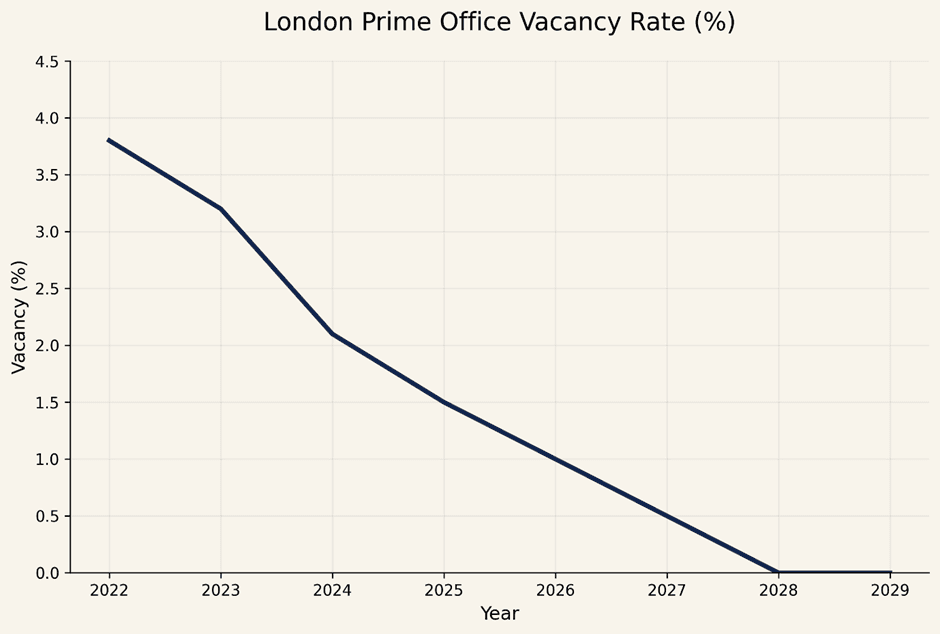
… and as a bonus (because I like charts), this is the London prime view - Knight Frank forecasts prime London office vacancy falling to effectively zero by 2028 and remaining there in 2029, driven by constrained supply and strong flight-to-quality demand:
So what? Scarcity at the top end of the office market flips the narrative from “structural decline” to “structural constraint”. Technology that accelerates leasing, improves space utilisation, enables retrofit, or surfaces off-market supply becomes materially more valuable in a zero-vacancy environment.
Source: Knight Frank (via FT reporting) -ft.com
5) Number of the Month
176% - the year‑on‑year increase in global proptech VC funding in January 2026 versus January 2025, with around $1.7bn deployed in a single month. So what? If sustained, this pace would make 2026 a record year for proptech funding - particularly for AI-first platforms directly influencing cost, income and risk.
cnbc.com · theaiconsultingnetwork.com
6) Operator Play of the Month
AI‑native roll‑ups of traditional agencies and managers. Dwelly’s £69m raise to acquire and digitise independent rental agencies under an AI‑enabled roll‑up model is a clear example of how tech and capital can modernise fragmented, analogue parts of the market.
So what? Expect similar plays across sales, block management and regional brokerage – incumbents should assume consolidation is coming and decide whether they want to be consolidators, partners or eventual targets. uktechnews.info
7) Policy & Regulation Radar
The English Digital Planning Programme continues to channel funding into local‑authority digital planning tools, with the latest PropTech Innovation Challenge projects due to complete in early 2026 and a focus on standardised data, APIs and plan‑making workflows. So what? For planning and GIS‑driven proptechs, this is a live opportunity to move from pilots into production systems and to help shape the “plumbing” of future digital planning infrastructure. localdigital.gov.uk · localdigital.gov.uk
RICS’ February 2026 assessment of the UK economy and property market underscores the importance of forthcoming rate cuts, updated planning frameworks and evolving landlord‑tenant regulation for transaction volumes and development viability. So what? Policy and monetary shifts are finally pointing in a friendlier direction, but developers and lenders will still need robust data and scenario analysis to navigate a more regulated, higher‑cost environment. rics.org
8) Deep Dives on Hot Topics
Special: MIPIM 2026 Preview from a Proptech Lens
MIPIM 2026 (Cannes, 9–13 March) has put proptech and AI firmly at the centre of its agenda rather than treating them as a fringe innovation track. Alongside the flagship “Housing Matters!” programme - focused on unlocking supply and tackling global housing shortages - this year’s official themes explicitly highlight “AI disruption, data centres and the road to net zero” as headline priorities. Nobel Prize-winning economist Philippe Aghion opens the event with a focus on how innovation and technology drive productivity, resilient urban development and the green transition - a framing that positions proptech not as software tooling, but as core economic infrastructure. For founders and investors, that signals something important: the industry conversation has shifted from “nice-to-have digital tools” to technology as a lever for systemic delivery and capital efficiency.
Beyond housing supply, the Leaders’ Perspective stage will carry sessions such as “Digital Real Estate Innovations” and “AI in Real Estate Investment: What’s Being Used, What’s Possible, and What’s Next?” - explicitly targeting CIOs, investment committees and strategists looking to convert AI from pilot projects into competitive advantage. That audience shift matters. These are not product demos; they are capital-allocation discussions. The implication for proptech founders is clear: positioning needs to evolve from “workflow automation” to demonstrable impact on underwriting, asset performance, risk modelling and portfolio strategy. MIPIM’s content suggests that boards and capital partners now expect AI to influence leasing velocity, retrofit economics, site selection, and capital deployment decisions - not just internal productivity.
On the ground, technology threads through asset-class sessions rather than sitting in a silo. The Data Centres Summit (“From bits to bricks”) reflects the explosive growth in AI-driven digital infrastructure and the scramble for power, land and planning certainty - fertile territory for data-centre specialists, energy optimisation platforms, and planning/data proptechs. Meanwhile, Road to Zero sessions such as “Intelligent Transitions: AI and Technology Powering the Net-Zero Shift” bring climate-tech and analytics platforms into direct dialogue with major owners and lenders. UK and city-focused events - including sessions on digital infrastructure for smarter cities - bridge local planning reform and global capital appetite. MIPIM 2026 looks set to be the densest annual concentration of serious proptech buyers, capital allocators and infrastructure partners anywhere in the global real estate calendar.
So what? MIPIM 2026 reinforces a structural shift: proptech is no longer competing for attention within real estate - it is embedded in the core conversations about productivity, capital allocation, net-zero transition and digital infrastructure. Founders and investors attending should approach with a clear articulation of where their platform sits in the AI × capital × net-zero × infrastructure intersection - because that is where board-level attention is now concentrated.
More information here: mipim.com
I’ll be there – message me to meet up or drop me an email at mike@growth-strategy.com.

Proptech × Fintech Intersect
CRETI and CNBC both highlight that much of the recent capital surge is going into platforms that blend fintech and proptech – fractional investment (Stake), AI‑enhanced agency roll‑ups (Dwelly) and credit/operations platforms that sit between lenders, borrowers and assets. So what? The most resilient business models remain those that sit at the intersection of capital flows and real assets – originators, marketplaces and infrastructure that handle money as well as data. uktechnews.info · cnbc.com
Recent market‑size work suggests the global proptech market could exceed $185bn by 2034, with Asia‑Pacific and North America leading growth thanks to smart‑city and digital‑infrastructure investment. So what? Investors and operators should think globally about where to deploy capital and products – particularly in regions where urbanisation and regulatory support for digital infrastructure are strongest. globenewswire.com
Dubai Land Department launched Phase II of its Real Estate Tokenisation Project, enabling secondary market resale from 20 February. So what? Liquidity is the step-change - secondary market functionality is what takes tokenisation from “novel issuance” to market infrastructure. dubailand.gov.ae
AI in Real Estate
Four new AI‑driven proptech unicorns – EliseAI, Bedrock Robotics, Vantaca and Juniper Square – now sit at the heart of leasing, construction, HOA/association management and investor relations for thousands of assets and LPs. So what? These companies show what “AI as infrastructure” looks like in practice: embedded across portfolios, automating routine work and generating data that feeds back into underwriting and operations. theaiconsultingnetwork.com
CRETI data suggests that AI‑first proptech firms are growing nearly twice as fast as non‑AI peers, and that around 70% of CRE firms now integrate AI into core operations. So what? For landlords, managers and lenders, the competitive disadvantage from not deploying AI is now visible in margin and growth gaps – making “do nothing” an increasingly untenable strategy. theaiconsultingnetwork.com
Young UK founders are targeting agent lead‑gen with new AI‑powered tools that turn portal traffic and online visits into instructions, aiming to give smaller agents enterprise‑grade marketing automation. So what? The AI revolution isn’t just happening in big‑ticket institutional workflows – it’s also reshaping the day‑to‑day economics of high‑street agency. thenegotiator.co.uk
Hexagon’s launch of “Hexagon Multivista” unifies reality capture, modelling and automated construction analysis services, reducing fragmentation across the construction data lifecycle. So what? The platform wars are expanding from “project management software” into “capture-to-insight” stacks - AI value will concentrate where data is most complete and continuously updated. aecmag.com
9) Events
London PropTech Show, London, 24–25 Mar 2026 - proptechshow.com
UKREiiF, Leeds, 19-21 May 2026 - ukreiif.com
PropTech Connect Europe, London, 9-10 Sep 2026 - proptechconnect.com
UK Events Programme: UK PropTech Association (UKPA) Events - ukproptech.com
Global events calendar – PropTechVision: proptechvision.com
10) Further Reading
PropTech AI Investment Surge – CRETI / AI Consulting Network. So what? Deep dive into where AI money is actually going, which verticals are hot, and why January’s funding spike may signal a record year. theaiconsultingnetwork.com
PropTech AI Unicorns and the platform shift. So what? Explores how EliseAI, Bedrock Robotics, Vantaca and Juniper Square reached unicorn status and what that means for CRE investors and operators. theaiconsultingnetwork.com
UK Economy & Property Market Update – February 2026 (RICS). So what? Authoritative view on rates, sentiment and sector‑by‑sector dynamics – useful context for investment committees and boards. rics.org
JLL Global Real Estate Perspective – February 2026. So what? A strong, board-friendly snapshot of macro, leasing and capital market momentum-and a useful anchor for 2026 strategy discussions. jll.com
UK Housing Market Update – February 2026 (Savills). So what? Clear read-through from transactions, affordability and demand/supply signals into the likely operating environment for housing and transaction-linked proptech. savills.co.uk
UK Real Estate Market Outlook 2026 (CBRE). So what? A sector-by-sector view of where capital and occupier momentum is building (living, data centres, logistics) and why supply constraints matter in 2026. cbre.co.uk
Market Overview – London PropTech Show. So what? A concise view on the UK proptech landscape, growth drivers and key themes ahead of the March show. proptechshow.com
Dubai Land Department: Real Estate Tokenisation (Project overview + services). So what? Primary source reference for the regulated tokenisation infrastructure that’s now moving into secondary market trading. dubailand.gov.ae
PropTech Innovation Challenge (Digital Planning Programme). So what? Shows where government‑backed digital‑planning pilots have been focused – and where procurement opportunities may emerge next. geovation.uk
State of the Market – February 2026 (CrowdProperty). So what? A concise, data‑rich summary of UK housing, lending and development dynamics - useful context for anyone operating at the intersection of proptech and specialist finance. crowdproperty.com
For UK residential property market insights, subscribe to the CrowdProperty UK newsletter – linkedin.com
For Australian residential property market insights, subscribe to the CrowdProperty Australia newsletter – linkedin.com
Mike Bristow
Founder of Growth Strategy. Operator, advisor and investor across strategy, capital, M&A and board roles.
About Mike
More perspectives
Strategy & Growth
Make sharper choices, build sustainable advantage and turn strategic intent into measurable enterprise value.
Capital
Secure and optimise the institutional capital required to lend, invest, acquire, build or scale.
M&A & Transactions
Prepare, position and execute acquisitions, disposals, liquidity events and strategic partnerships.
Board & Executive
Add experienced judgement, challenge and execution capacity at board and executive level.