Proptech Briefing
1) Key Takeaways
Pi Labs’ new Growth Programme cohort says a lot about where smart capital thinks the built environment is going: the 14th cohort is explicitly built around agentic AI across the construction lifecycle, from due diligence and planning approvals to structural engineering automation and voice-led site/admin workflows. The five companies selected are Veridue, Bite, AutoSitu, Movable and Unbane. So what? This is a very clear signal that the next wave of value is expected to come from AI that executes real work across construction and real-asset workflows, not just assists with analysis. startupsmagazine.co.uk · pilabs.vc · linkedin.com
The London Business School Real Estate Conference reinforced that operating capability is becoming the moat: the most interesting takeaway from the conference was not a sector call but the view that real estate is becoming more selective, more operational and far less forgiving, with repeatable operating platforms, data, AI and sustainability execution increasingly defining competitive advantage. So what? Sector allocation alone is not enough anymore; owners, investors and operators increasingly need platforms that improve execution, liquidity, cost control and resilience. linkedin.com
UKREiiF 2026 pushed proptech further into mainstream delivery conversations: the UK PropTech Hub returned for a third year, partnered by MHCLG and sponsored by JLL, while event content leaned heavily into digital transformation, digital planning, AI readiness and “infrastructure before intelligence.” So what? The UK conference signal is now similar to MIPIM’s: proptech is being taken more seriously where it connects to delivery, planning, infrastructure and public/private execution rather than standalone innovation theatre. ukproptech.com · ukproptech.com · scottishpropertyfederation.org.uk · linkedin.com
Capital is still backing construction and transaction workflows where ROI is obvious: May’s cleaner funding signals included Pillar’s €12m seed round for an AI operating system for construction and Rely’s $4.5m seed round for AI-powered multifamily diligence. So what? Investors are still leaning into platforms that reduce manual review, improve workflow speed and tighten operational control in places where errors are expensive and labour is scarce. proptechbuzz.com · finsmes.com · proptechbuzz.com
CrowdProperty’s May market note points to a market that is still investable, but increasingly selective: its May takeaways highlight softer house prices but underlying stability, diverging mortgage pricing, widening regional divergence, a preference for smaller and more flexible developments, and the growing importance of strong equity positions. So what? Developers and lenders still have opportunity, but only where discipline, flexibility and resilience are built into the business plan. crowdproperty.com
The HBF Housing Pipeline Report Q4 2025 is still not out - and that is becoming more meaningful by the week: HBF’s pipeline pages still show Q3 2025 as the latest published report, while Savills and wider industry commentary point to weak permissions data and a still-thin supply pipeline. So what? Until official Q4 2025 data appears, live planning intelligence, market sentiment and real-time developer commentary are more important than ever - especially given the political sensitivity around housing commitments. hbf.co.uk
2) VC/PE Investment Activity
Pillar raises €12m in seed funding to expand its AI-powered operating system for construction, with the round led by Earlybird and Base10. The company is focused on helping contractors run economic and operational workflows more effectively. So what? Construction software is attracting capital where it helps users make better commercial decisions and operate with tighter control, not just digitise forms. proptechbuzz.com · finsmes.com · thesaasnews.com
Pi Labs’ 2026 Growth Programme has now kicked off, selecting five agentic-AI companies across the built environment value chain after reviewing more than 1,500 applications. Themes span energy-infrastructure diligence, structural engineering automation, planning approvals and voice-led workforce / construction admin workflows. So what? This is one of the clearest signals this month that specialist VC is concentrating around AI that can automate bottlenecks across construction and real assets. startupsmagazine.co.uk · pilabs.vc · linkedin.com
LightTable raises $22m Series A to scale AI-native pre-construction workflows for design and construction teams. So what? Pre-construction is becoming a serious AI battleground because catching errors, reducing RFIs and speeding pricing decisions has a direct and measurable downstream effect on project economics. globenewswire.com · thesaasnews.com
Rely raises $4.5m seed to expand its AI-powered transaction diligence platform for multifamily real estate. So what? This is another example of capital going into document-heavy, time-consuming real estate workflows where automation directly improves speed and confidence in decision-making. proptechbuzz.com
UK proptech remains investable, but concentrated: Beauhurst’s May profiling of the top 100 UK proptech companies says the sector has raised £3.05bn in equity funding to date, with £230.4m raised in 2025 versus £192.4m in 2024. So what? The funding backdrop is healthier than a year ago, but still selective enough that scale, traction and differentiation matter hugely. beauhurst.com
Construction remains ground zero for AI-driven productivity: from Conxai and Neuron Factory through to Pillar’s €12m round and the Pi Labs cohort, investor conviction remains strongest where AI can tackle fragmented site data, pre-construction risk and margin leakage. So what? Expect many of 2026’s most interesting AI stories to look like infrastructure for messy physical work, not just copilots for knowledge workers. proptechbuzz.com · globenewswire.com · startupsmagazine.co.uk
The UK proptech funding picture is improving, but not broad-based: Beauhurst’s data show a healthier funding backdrop, but the sector remains highly concentrated and London-heavy. So what? For founders, there is more appetite than a year ago, but the market still rewards breakout quality rather than average quality. beauhurst.com
3) Market Insights
CrowdProperty’s May State of the Market describes a selective rather than exuberant market: house prices edged down but remained broadly stable, mortgage pricing diverged as lender competition returned, regional divergence widened, smaller developments were increasingly preferred, and strong equity positions mattered more. So what? In practice, flexibility and resilience are becoming more important than sheer optimism in residential development. crowdproperty.com
The LBS Real Estate Conference 2026 pointed to a more operational phase for the asset class: your post distilled five themes - operating platforms as strategy, debt/equity repricing, fundraising and liquidity stress, regulation/affordability/geopolitics as underwriting variables, and no room for lazy sector allocation. So what? The real estate opportunity set in 2026 is being shaped less by broad asset-class narratives and more by execution quality, platform capability and selectivity. linkedin.com
UKREiiF strengthened the same themes from a UK public/private market angle: the event’s proptech programming revolved around digital transformation, planning, infrastructure, AI readiness and moving from insight to action one year after “The Opportunity for PropTech” report with MHCLG. So what? In the UK, the most credible proptech discussion is now about implementation, public-private workflow change and delivery infrastructure - not abstract innovation. scottishpropertyfederation.org.uk · ukproptech.com · ukproptech.com
The HBF pipeline hole is still there: HBF’s public pages still show Q3 2025 as the latest Housing Pipeline Report, while industry commentary using HBF/Glenigan data suggests that around 186,000 homes got full planning consent in the year to Q1 2026 and that annualised consents are well below prior peaks. So what? Housing delivery is still operating with an uncomfortable mix of weak supply data and delayed official visibility. hbf.co.uk · linkedin.com · savills.co.uk
ROI-led proptech adoption is becoming standard buyer language: COR Advisors and MRI both make the case that measurable savings, integrated data and platform-level adoption are the dividing line between “good” and “forgettable” proptech in 2026. So what? Buyers are becoming more ruthless about implementation paths, payback periods and system integration. coradvisors.net · coradvisors.net · mrisoftware.com
AI infrastructure remains a physical-world story as much as a software one: “powered land”, grid access and infrastructure-ready sites continued to dominate commentary this month. So what? Real estate’s AI story is increasingly tied to land, energy, planning and connections - not just applications. reuters.com · pwc.com
4) Chart of the Month
The most important chart in housing right now is not house prices. It is the gap between political ambitions for housing supply and the much weaker level of real permissions coming through the system.
English homes gaining full planning consent are still running miles below where they need to be - and the official Q4 2025 HBF update still hasn’t arrived. Infilling these across various market commentator data points show perennial decline, and no. it’s not a new dawn:
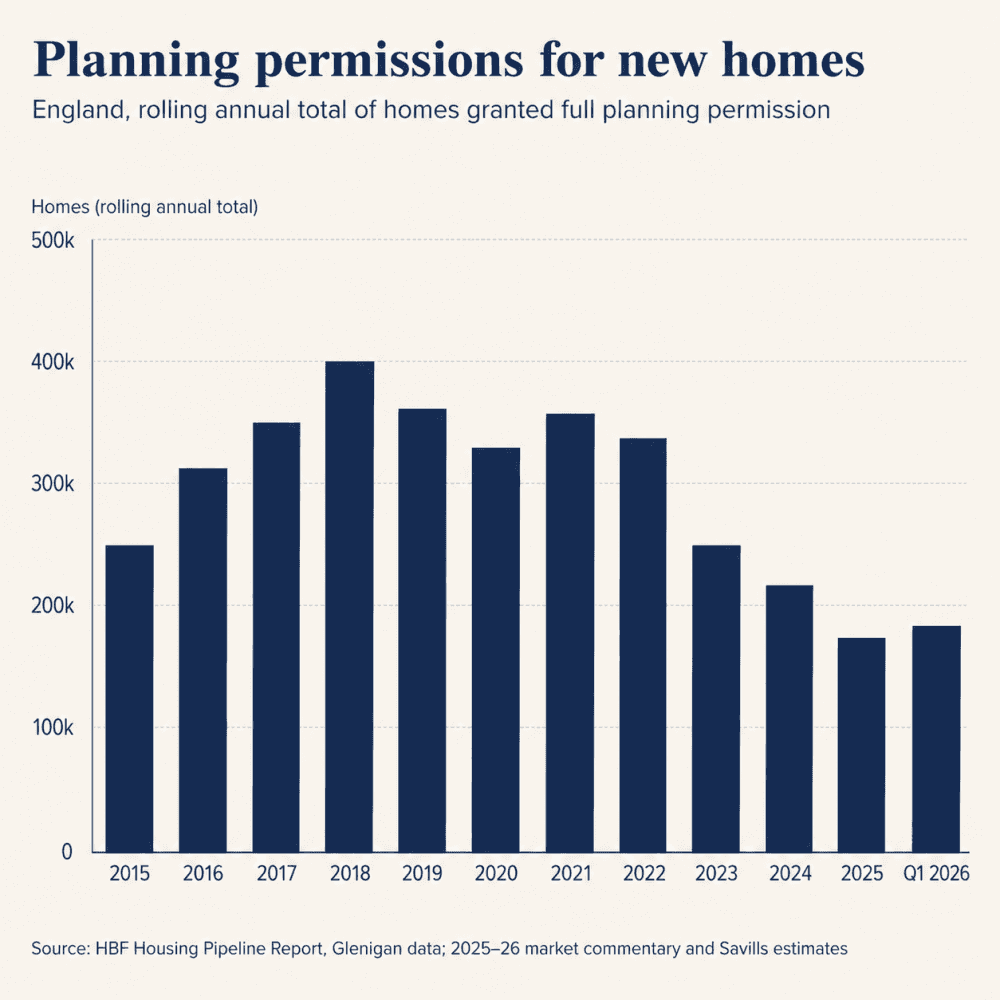
So what? Even with a small recent uptick, the permissions pipeline remains far too weak to support stated housing ambitions - which is why planning intelligence, viability tools and delivery-focused proptech remain so relevant.
Good to see Oliver Lowrie also shining a light on this political, and more importantly, economic car-crash situation.
Sources: linkedin.com · hbf.co.uk · savills.co.uk
5) Number of the Month
27% - the estimated year-on-year fall in English housing planning consents in 2025, according to Savills’ analysis of HBF/Glenigan data, with London permissions more than halving. These estimated 186,000 approvals won’t all get built and are effectively the outlook for the next 2-3 years of housebuilding output.
So what? Against manifesto-level promises on housing delivery, that number points to a structural rather than cyclical problem - and increases the strategic value of any technology that improves planning intelligence, viability and delivery.
Source: savills.co.uk
6) Operator Play of the Month
Operating platforms are becoming the strategy. That was one of the clearest messages from the London Business School Real Estate Conference and it fits neatly with the better proptech stories in market: repeatable operating capability, data, cost control, AI and sustainability execution are increasingly the moat.
So what? The operator edge in 2026 will come less from broad exposure to “good sectors” and more from having the systems, discipline and execution capability to run assets better than peers. linkedin.com
7) Policy & Regulation Radar
The still-missing HBF Q4 2025 pipeline report is becoming a policy-adjacent issue in its own right: whether the delay is administrative or due to data verification, it is leaving the market without a fresh official view of approvals at a time when housing delivery is politically loaded and under pressure. So what? This strengthens the case for live planning intelligence, digital planning infrastructure and better real-time data across the housing pipeline. hbf.co.uk · hbf.co.uk · localdigital.gov.uk
UKREiiF’s policy-tech signal was about implementation, not slogans: digital planning standards, local-authority tooling and the “progress since The Opportunity for PropTech” session all point to a policy agenda focused on making technology work inside actual public-sector processes. So what? The opportunity is shifting from one-off pilots to reusable infrastructure and workflow adoption. scottishpropertyfederation.org.uk
8) Deep Dives on Hot Topics
Special: Pi Labs’ new Growth Programme cohort says where the next built-environment AI value may be created
Pi Labs’ 14th annual Growth Programme is one of the most useful “where smart money is looking” signals this month. After assessing more than 1,500 applicants, the new cohort is built around a very clear thesis: agentic AI can automate large parts of the construction and real-asset value chain, moving the industry closer to what Pi Labs describes as the “self-coordinating site.” The programme itself is a 10-week growth programme for early-stage companies transforming the built world, backed by a £350,000 SAFE structure and a focus on digitalising real estate and decarbonising construction. startupsmagazine.co.uk · pilabs.vc · linkedin.com
The five companies themselves sketch out a useful map of where the bottlenecks still are. Veridue focuses on AI-driven diligence for energy infrastructure deals, flagging issues faster so teams can move with more confidence. Bite automates structural-engineering workflows, including detecting design changes and their downstream impacts in real time. AutoSitu is aimed at planning approvals, using coordinated AI agents to check zoning, building codes and local compliance and reportedly cutting planning timelines by 90%. Movable uses voice AI to capture insight from deskless workers before shifts, during issues and after jobs, effectively creating a better operational feedback loop. Unbane uses voice AI to replace construction admin, turning calls into structured, audit-ready records. startupsmagazine.co.uk · linkedin.com
So what? The interesting thing about this cohort is not just that it is “AI-heavy.” It is that the companies are all aimed at expensive, messy, high-friction workflows where execution matters and the ROI case is easier to see. That feels exactly right for where the built environment is in 2026.
Proptech × Fintech Intersect
The most useful lending insight this month came from London Business School’s Real Estate Conference rather than a pure proptech source: one of the clearest messages was that debt/equity repricing, liquidity stress and platform quality are now central to how real estate capital is being allocated. In other words, capital is still available, but it is flowing toward operators and originators that can combine disciplined underwriting with repeatable execution. So what? The winners at the property/fintech intersection will be the platforms that treat operations, reporting and liquidity management as core product, not back-office hygiene. linkedin.com
Rocket/Redfin and Real/REMAX are no longer just brokerage stories - they are distribution-plus-financing stories: both deals underline that customer ownership, lead flow, mortgage attachment and data are still some of the most valuable assets in the housing stack. So what? The strongest fintech/proptech models still sit where customer journey control meets capital flow - because that is where margin, insight and cross-sell compound. ir.rocketcompanies.com
AI in Real Estate
Pi Labs’ new Growth Programme cohort is a much better May signal than generic “AI in real estate” commentary: the selected companies are pointed squarely at real bottlenecks - diligence for energy infrastructure, structural engineering automation, planning approvals, voice-led workforce capture and construction admin. So what? The AI opportunity is narrowing into very specific workflow pain points where automation can remove friction, shorten timelines and generate an obvious ROI story. startupsmagazine.co.uk · pilabs.vc
Pillar and LightTable show where investors still see headroom in contech AI: Pillar’s €12m seed round and LightTable’s $22m Series A both back AI systems aimed at improving construction and pre-construction execution rather than producing prettier analytics. So what? The market is still willing to fund AI in the built environment when it tightens commercial control, catches errors earlier and reduces expensive workflow drag. proptechbuzz.com · finsmes.com · globenewswire.com
The more interesting buyer trend this month is not “more AI” but tougher procurement discipline: CORA Advisors and MRI both make the case that integrated platforms with measurable savings are pulling away from disconnected tools and shallow AI overlays. So what? In 2026, AI products in real estate are increasingly being judged like infrastructure purchases: does it fit the stack, does it save money, and does it make a real operational difference? coradvisors.net · coradvisors.net · mrisoftware.com
UKREiiF also reinforced that AI in the built environment will compound fastest where it plugs into planning, delivery and operating workflows rather than sitting outside them.So what? In the UK, the winners are likely to be the platforms that fit into real public/private processes rather than selling AI as a standalone concept. ukproptech.com · ukproptech.com · scottishpropertyfederation.org.uk
9) Events
Digital Construction Week, London, 3–4 June 2026 - digitalconstructionweek.com
London Tech Week, London, 8–12 June 2026 - londontechweek.com
Real Estate:UK (RE:UK) Annual Conference 2026, London, 7 July 2026 - ukproptech.com
PropTech Connect Europe, London, 9-10 Sep 2026 - proptechconnect.com
UK Events Programme: UK PropTech Association (UKPA) Events - ukproptech.com
Global events calendar – PropTechVision: proptechvision.com
10) Further Reading
VC Pi Labs backs five Agentic AI startups. So what? The clearest summary this month of where specialist proptech VC thinks the next workflow value lies. startupsmagazine.co.uk
Growth Programme - Pi Labs. So what? Useful on programme structure, ticket, stage and thematic focus. pilabs.vc
State of the Market – May 2026 (CrowdProperty). So what? A concise read on pricing, lender competition, regional divergence and developer resilience. crowdproperty.com
Top 100 PropTech Companies in the UK | 2026 (Beauhurst). So what? Useful for framing how concentrated UK proptech funding remains and where the capital has actually gone. beauhurst.com
6 PropTech Trends Driving Real Estate ROI in 2026. So what? A practical checklist of the categories buyers are finding easiest to justify. coradvisors.net
Investor Views on PropTech Adoption in 2026: ROI, Risks, and Returns. So what? A useful companion piece on how investors are thinking about proptech as a returns driver rather than an add-on. coradvisors.net
Housing Market Update – April 2026 (Savills). So what? Helpful context on how Q1 momentum is meeting renewed rate pressure. savills.co.uk
For UK residential property market insights, subscribe to the CrowdProperty UK newsletter - linkedin.com
For Australian residential property market insights, subscribe to the CrowdProperty Australia newsletter - linkedin.com
Mike Bristow
Founder of Growth Strategy. Operator, advisor and investor across strategy, capital, M&A and board roles.
About Mike
More perspectives
Strategy & Growth
Make sharper choices, build sustainable advantage and turn strategic intent into measurable enterprise value.
Capital
Secure and optimise the institutional capital required to lend, invest, acquire, build or scale.
M&A & Transactions
Prepare, position and execute acquisitions, disposals, liquidity events and strategic partnerships.
Board & Executive
Add experienced judgement, challenge and execution capacity at board and executive level.