Proptech Briefing
1) Key Takeaways
Pi Labs gives June its clearest construction AI framework: The Self Co-ordinating Site maps 988 AI/contech companies across scanning and perception, intelligence, and action/robotics, and argues that the market is moving from tools that observe and analyse toward connected agents that coordinate work on site. So what? The most interesting construction AI is no longer document summarisation or prettier dashboards; it is intelligence that can perceive, decide and eventually act across the project lifecycle. pilabs.vc
Companion.energy’s €7.8m seed round shows energy moving from cost centre to operating system: the Ghent-based platform, co-led by Pi Labs and Realyze Ventures, helps large industrial and commercial clients manage energy in real time across contracts, sites and flexible assets. So what? For real assets, energy optimisation is shifting from procurement and reporting into live execution - a much more valuable layer as electrification, flexibility, grid constraints and price volatility increase. companion.energy · eu-startups.com · esgtoday.com
Fifth Dimension’s $26m Series A reinforces the move from AI tools to institutional decision infrastructure: the London-based real-assets AI platform, led by HV Capital, connects fragmented data rooms, spreadsheets, ERPs and documents into a decision-intelligence layer for investment and asset management teams. So what? Real-estate AI that wins institutional budgets will need to be secure, integrated and audit-defensible, not just clever. fifthdimensionai.com · proptechconnect.com
The UK housing market looks weaker and more political at the same time: Savills now expects mainstream UK house prices to fall 2.0% this year, CrowdProperty’s June note highlights affordability constraints and subdued construction activity, Berkeley is calling for tax and regulatory reform, and Starmer’s resignation adds another layer of uncertainty to planning, housing delivery and devolution. So what? Planning reform alone will not be enough if affordability, confidence, construction capacity, tax design and political stability all remain fragile. savills.co.uk · crowdproperty.com · reuters.com · reuters.com
Transaction friction is becoming harder to ignore: HMRC’s latest data show April residential transactions down 3% month-on-month, RSM says Q1 completions were around 30,000 below the five-year quarterly average, and Tax Policy Associates estimates the April 2025 stamp duty increase will mean around 30,000 fewer residential transactions per year. So what? A market already struggling with affordability and confidence does not need taxes that make moving house less rational and reduce the wider economic activity around transactions. gov.uk · rsmuk.com · taxpolicy.org.uk
Dubai’s PropTech Hub is becoming a more serious international landing platform: its first Global Landing Pad cohort includes Interloom, Watergate AI, Rensair, Demand Logic, UTwin and Smart Spaces, with the programme designed to connect scale-ups to regulators, developers, investors and pilot opportunities in Dubai. So what? MENA is moving from being a proptech sales destination to an active deployment and localisation market for serious international scale-ups. arabfounders.net · innovationhub.difc.ae · difc.com
2) VC/PE Investment Activity
Companion.energy raises €7.8m in an oversubscribed seed round co-led by Realyze Ventures and Pi Labs, with Asterion Ventures and existing investors also participating. The platform manages live energy operations for industrial and commercial clients, including batteries, solar, EV charging and other flexible assets. So what? Energy management is becoming a software execution problem, not just a procurement or reporting problem - and that matters for every major real-asset owner dealing with volatile power costs and decarbonisation targets. companion.energy · eu-startups.com · esgtoday.com
Fifth Dimension raises a $26m Series A led by HV Capital, with participation from Prudence, Mercia Ventures, MMC Ventures and AFG Partners, taking total funding above $40m. Its agentic AI layer unifies fragmented institutional and market data to screen deals, draft IC memos and surface risk, and is funding US and Asia-Pacific expansion. So what? Document-heavy, judgement-critical real-asset workflows are proving to be one of the clearest ROI cases in proptech - and UK founders are building category leaders in it. fifthdimensionai.com · eu-startups.com · credaily.com
Structured AI raises $4.2m seed funding led by FCVC, with Y Combinator, 20VC, Cherry Ventures and Sequoia Scout among the backers, for AI-powered QA/QC agents that check completed site work against construction documents. So what? This is the construction perception/action thesis in miniature: vision models good enough to read site reality and verify it against the design, where catching errors early has obvious measurable value. enr.com · getstructured.ai · thesaasnews.com
Enlaye raises $5m seed funding, led by Glasswing Ventures and Link Ventures, to scale its AI-native risk lifecycle platform for construction and infrastructure projects. The company is using graph-based models to turn fragmented project data into predictive risk intelligence. So what? Construction risk - the gap between bid, contract, change order and claim - is exactly where margin leakage and disputes start; moving it from static registers into AI-native prediction is a textbook example of the data flywheel Pi Labs’ report describes. glasswing.vc · enr.com · thesaasnews.com
Square Yards raises around Rs 900 crore / c.$95m in a mix of debt and equity, reportedly pushing the India-based real estate and mortgage platform into unicorn territory ahead of a planned IPO. So what? Outside the UK/US lens, full-stack property platforms that combine search, transaction, finance, property management and interiors are still attracting serious growth capital. timesofindia.indiatimes.com · yourstory.com · business-standard.com
PropTechBuzz’s June flow also points to breadth beneath the headline rounds: Rize raised seed funding for rent-now-pay-later in Saudi Arabia, Artis secured $7.3m for an AI-powered marketing platform for residential design professionals, and Agenz raised $5m to expand its AI real-estate data platform in Morocco. So what? AI, payments, data and operations are spreading geographically; the common thread is still the same - recurring workflows, distribution advantage and measurable ROI. proptechbuzz.com · proptechbuzz.com · proptechconnect.com
3) Market Insights
Savills’ June Housing Market Update is a sharp downgrade in tone: UK house prices fell 0.6% in May, annual growth slowed to 1.7%, and Savills now expects house prices to fall 2.0% this year, with the largest falls in the least affordable markets. So what? The housing market is not simply waiting for rates to fall; affordability, confidence, geopolitics and policy uncertainty are all feeding into weaker near-term expectations. savills.co.uk · savills.co.uk
Savills’ completions forecast is even more worrying for housebuilding: new homes completions in England are forecast to average 167,500 per year over the five years to 2029/30, with only around 152,000 completions in 2026/27 and unsupported private completions falling to around 96,000, the lowest since 2015. So what? This is a structural delivery problem, not a cyclical wobble - and it sharpens the value of planning intelligence, viability modelling and better delivery tooling. savills.co.uk
CrowdProperty’s June State of the Market describes a market characterised by stability rather than momentum: house prices paused, affordability remains the key constraint, rate visibility has improved, planning-ready sites command a premium, construction activity remains subdued and flexible funding structures matter more. So what? SME developers need certainty, not just capital - planning certainty, realistic pricing, robust contingencies and finance that fits the project rather than just the headline rate. crowdproperty.com
Official planning data remain uncomfortable: MHCLG says district-level authorities received 79,600 planning applications in Q1 2026, down 10% year-on-year, while residential applications granted in the year to March 2026 were down 4%. So what? The planning system is not yet showing the volume signal needed to support a genuine housebuilding recovery, even before viability and build-out constraints are considered. gov.uk
The HBF Housing Pipeline Report remains a live data-gap story: HBF’s public pages still list Q3 2025 as the latest report, despite the market now relying on partial Glenigan, Savills and official planning proxies. So what? When housing supply is politically central and operationally weak, delayed official pipeline visibility itself becomes a signal - and a tailwind for better live planning data. hbf.co.uk · hbf.co.uk · savills.co.uk
Berkeley’s latest warning makes the London delivery problem impossible to ignore: the group called for tax and regulatory reform after a profit fall, with reporting noting that London is delivering less than 10% of the homes it needs and that development timelines have stretched materially. So what? The London housing problem is no longer just planning rhetoric; it is a viability, tax, regulation and demand problem at the same time - exactly where better planning intelligence and delivery tooling matter, but cannot solve everything alone. reuters.com · thetimes.com
Transactions remain a weak point beneath the surface: HMRC recorded 101,030 seasonally adjusted UK residential transactions in April, down 3% from March, while RSM says Q1 completions were around 30,000 below the five-year quarterly average. So what? A high-friction, low-liquidity housing market is not healthy for buyers, sellers, agents, lenders or the wider economy. gov.uk · rsmuk.com
Proptech funding still looks healthy but selective: CRETI says proptech companies raised $353m across 39 deals in May 2026, with a median round of $11m, and construction/development leading sector allocations. So what? The market is funding the category, but not indiscriminately; the bias remains toward operating systems, core workflows and companies with measurable adoption. creti.org · creti.org
Dubai is making an explicit, well-capitalised play to be the world’s proptech testbed: DIFC’s PropTech 2033 work identifies more than AED 53bn in potential annual productivity gains, tracks 231 UAE proptech firms, and underpins the Global Landing Pad for international scale-ups. So what? For UK and European founders facing a soft domestic market, the Gulf’s combination of capital, regulatory agility and new-build pipeline is becoming a serious second home. difc.com · gulfbusiness.com
4) Chart of the Month
Pi Labs’ AI Tech Stack for Construction - “from seeing, to thinking, to doing”.
The chart of the month is Pi Labs’ construction AI market map from The Self Co-ordinating Site report. It divides the AI stack into three layers - scanning and perception, intelligence, and action/robotics - and maps those layers across pre-construction, construction and post-construction:
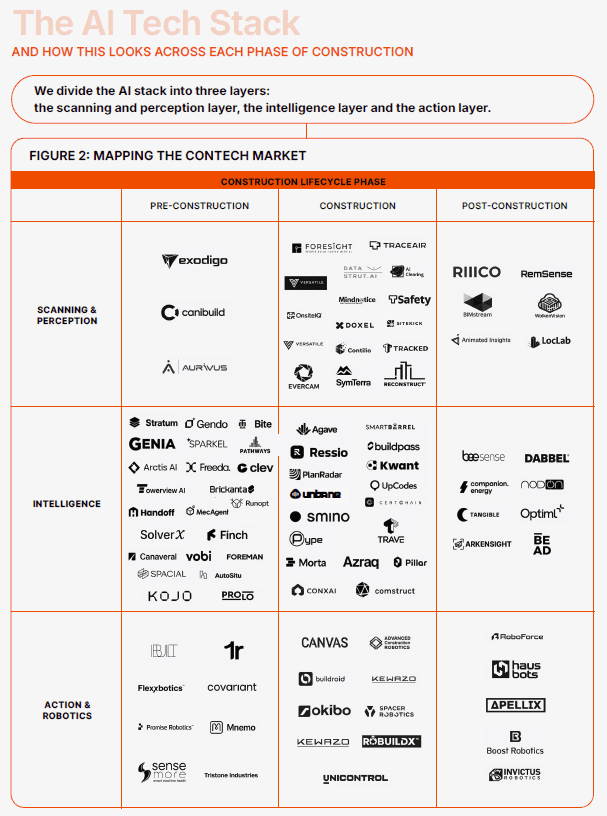
So what? This is the cleanest visual expression of where construction AI is going. The market is not just moving from analogue to digital; it is moving from tools that observe, to tools that decide, to systems that act. That is why the “self-co-ordinating site” is a more useful framing than generic “AI in construction.”
Source: Pi Labs, The Self Co-ordinating Site - pilabs.vc
5) Number of the Month
96,000 - Savills’ estimate of unsupported private new-home completions in England in 2026/27, the lowest level since 2015, within a total forecast of just over 150,000 completions for the year.
So what? Against manifesto-level promises on housing delivery - and now a leadership change at the very top of government - that number points to a structural rather than cyclical shortfall. It also raises the strategic value of any technology that improves planning intelligence, viability and delivery throughput. savills.co.uk
6) Operator Play of the Month
Energy operating systems for real assets.Companion.energy is the clearest operator play this month: a platform that moves energy management from monitoring and procurement into continuous optimisation and execution across flexible assets, tariffs and market exposure.
So what? For real estate and infrastructure operators, energy is becoming a live operating variable. The winners will be the platforms that can connect physical assets, tariffs, batteries, solar, EV charging and market signals into automated decisions - especially as volatility, electrification and grid constraints intensify. companion.energy · thenextweb.com · esgtoday.com
7) Policy & Regulation Radar
The stamp duty debate is moving from tax policy into market-functionality territory: Tax Policy Associates argues the April 2025 stamp duty increase likely raised receipts but will still mean around 30,000 fewer moves per year and roughly £300m of lost moving-related spending. So what? A tax can be fiscally successful and economically damaging at the same time; property transaction taxes should be judged against liquidity, labour mobility and wider housing-market function, not just annual receipts. taxpolicy.org.uk · rsmuk.com
Housing policy is heading into another leadership transition, with the state’s role in play: Starmer’s resignation, Burnham’s likely leadership and reports that ministers are exploring a state-owned housing developer all add uncertainty to a market already struggling with affordability, planning and build-out. So what? Developers and investors need to watch whether the next phase of policy is about enabling the private market, replacing parts of it, or trying to do both at once. reuters.com · theguardian.com
Digital planning remains one of the more investable policy-tech themes: the latest official planning statistics show applications and residential grants still falling, while UKREiiF and the UK PropTech Hub continued to frame digital planning, data standards and implementation as practical delivery themes. So what? The opportunity is not “planning tech” as a slogan; it is tools that help local authorities and developers move evidence, applications, infrastructure constraints and decisions through the system faster. gov.uk · ukproptech.com · localdigital.gov.uk
8) Deep Dives on Hot Topics
Special: Pi Labs maps the road to the “self-co-ordinating site”
Pi Labs’ new report, The Self Co-ordinating Site: How AI is Transforming Construction, is one of the most useful pieces of built-environment research this month. Drawing on an analysis of 988 companies, it argues that construction is finally approaching its long-awaited productivity inflection point: a $13tn industry where productivity has effectively flatlined for decades, 12-30% of project cost is lost to preventable rework, and 98% of megaprojects finish late or over budget.
The report’s central framework divides the contech stack into three layers - scanning and perception, intelligence, and action/robotics - and maps them across the construction lifecycle. Its key insight is that agentic AI becomes the connective tissue between those layers: an AI that does not merely flag a scheduling clash, but resolves it by reassigning trades, reordering materials and updating the programme without waiting to be asked.
It is also clear-eyed about why construction has resisted disruption: fragmented actors, siloed data, bespoke designs, project-specific parameters, liability, regulation, cost of entry and an acute AI skills gap. The winners will not be generic copilots. They will be workflow-native systems that plug into messy site realities, proprietary data environments and real operational accountability.
So what? This is the clearest articulation yet of where built-environment value is heading - and the capital is already moving in the same direction. For investors, operators and founders, the report is well worth reading in full.
Download it here: pilabs.vc
Proptech × Fintech Intersect
Real-asset “decision intelligence” is where proptech and capital allocation now meet: Fifth Dimension’s $26m Series A is, at heart, a fintech story - it compresses deal cycles, drafts IC memos and monitors portfolio variance, with sourced, audit-defensible conclusions for institutional capital that demands governance. So what? The winners at the property/fintech intersection will be platforms that treat underwriting, reporting and risk as core product, because that is where capital decisions are actually made. fifthdimensionai.com
Energy is becoming a financial-optimisation layer for real assets:Companion.energy connects contracts, operational systems and distributed assets, continuously forecasting demand and automating procurement and asset decisions to reduce costs and optimise market exposure. So what? As buildings acquire solar, storage and EV charging, energy stops being a fixed cost and becomes a tradable, optimisable asset - a fast-growing frontier where proptech, energytech and fintech converge. thenextweb.com · companion.energy
Axonic’s $400m multifamily loan securitisation is a useful US signal for property-credit platforms: the transaction covered 47 loans across 22 states with a weighted-average LTV of 68.13%, and Axonic says the wider proprietary programme is targeting more than $2bn of originations this year. So what? Specialist real-estate credit is becoming more structured, data-heavy and platformised - exactly the direction UK originators need to keep moving in if they want durable institutional funding. axoniccap.com · proptechbuzz.com
Stamp duty remains one of the most obvious frictions in the UK property/fintech stack: Tax Policy Associates estimates the April 2025 increase will produce around 30,000 fewer residential transactions a year, while RSM says Q1 completions were already about 30,000 below the five-year quarterly average. So what? Transaction tech can improve speed and certainty, but tax design still sets the market’s liquidity ceiling; technology cannot fully compensate for fiscal friction that makes moving economically irrational. taxpolicy.org.uk · rsmuk.com
AI in Real Estate
The Pi Labs report is a better signal than generic “AI in real estate” commentary: it pinpoints where AI is crossing thresholds - prediction, generation, autonomy and action - and why the action layer, including robots, agents and MCP tools wired into BIM, is the hard, valuable frontier. So what? The AI opportunity in the built world is narrowing into specific, high-friction workflows where automation removes friction, shortens timelines and produces an obvious ROI story. pilabs.vc
Vision-led, document-grounded AI keeps attracting capital: Structured AI’s computer-vision QA/QC agents, Enlaye’s graph-based risk models and Fifth Dimension’s data-unification layer all back AI that reads real-world inputs - site work, project files or institutional documents - and checks them against a source of truth. So what? Buyers and investors are judging real-estate AI like infrastructure: does it fit the stack, does it save money, and does it make a measurable operational difference? enr.com · enr.com · fifthdimensionai.com
The June founder signal is “embedded, not bolted on”: the strongest proptech makes leasing, maintenance, energy reporting and building operations easier inside the tools people already use, with clean data and human-in-the-loop checks. So what? Products that change the workflow itself, rather than adding another dashboard, are the ones pulling away from the pack. blog.mean.ceo
The June PropTechBuzz flow shows AI spreading into the wider real-estate operating stack: Artis is targeting residential design marketing, Agenz is building AI-powered real-estate data intelligence in Morocco, and Mygate is expanding residential community operations in India. So what? AI adoption is becoming geographically and functionally broader, but the same rule applies everywhere: the tool needs to attach to a recurring workflow, data asset or distribution advantage. proptechbuzz.com · thesaasnews.com · proptechconnect.com · yourstory.com
9) Events
Real Estate:UK (RE:UK) Annual Conference 2026, London, 7 July 2026 - ukproptech.com
PropTech Connect Europe, London, 9-10 Sep 2026 - proptechconnect.com
EXPO REAL (Messe München), Munich, 5-7 October 2026 - exporeal.net
MIPIM Middle East, Riyadh, 20-21 October 2026 - mipim.com
Future Proptech Summit Summit (#FPS26), Dubai, 2026 - futureproptechsummit.com
UK Events Programme: UK PropTech Association (UKPA) Events - ukproptech.com
Global events calendar – PropTechVision: proptechvision.com
10) Further Reading
Pi Labs: The Self Co-ordinating Site. So what? The key construction AI paper this month and the best framework I have seen for moving from tools to autonomous site coordination. pilabs.vc
Companion.energy raises €7.8m to build the energy operating system for European industry. So what? Useful on why energy optimisation is becoming operational software. companion.energy
Fifth Dimension raises $26m Series A. So what? Strong read on institutional real-assets AI, auditability and decision intelligence. fifthdimensionai.com
State of the Market - June 2026 (CrowdProperty). So what? Practical read for SME developers on affordability, rates, planning-ready sites, construction pressure and funding structure. crowdproperty.com
Housing Market Update - June 2026 (Savills). So what? Clear explanation of the weaker near-term housing outlook and revised 2026 price forecast. savills.co.uk
Housing Completions Forecast for England - June 2026 (Savills). So what? The clearest near-term read on just how weak the housebuilding pipeline has become. savills.co.uk
Planning applications in England: January to March 2026 (MHCLG). So what? Important official context on applications, decisions and residential grants. gov.uk
Why do we still have stamp duty? (Tax Policy Associates). So what? A sharp, evidence-led explanation of why stamp duty can raise revenue while still damaging market efficiency. taxpolicy.org.uk
Berkeley calls for tax and regulatory rethink after profit fall (Reuters). So what? Strong read-through from housebuilder performance into viability, policy and delivery constraints. reuters.com
Dubai PropTech Hub Selects Six Global Startups for its First International Landing Pad Cohort. So what? Good read on Dubai’s attempt to turn proptech into regulated, deployable urban infrastructure. arabfounders.net
CRETI: Proptech Venture Capital by Funding Stage - May 2026. So what? Useful evidence that capital is active but still heavily concentrated around traction and core workflows. creti.org
For UK residential property market insights, subscribe to the CrowdProperty UK newsletter - linkedin.com
For Australian residential property market insights, subscribe to the CrowdProperty Australia newsletter - linkedin.com
Mike Bristow
Founder of Growth Strategy. Operator, advisor and investor across strategy, capital, M&A and board roles.
About Mike
More perspectives
Strategy & Growth
Make sharper choices, build sustainable advantage and turn strategic intent into measurable enterprise value.
Capital
Secure and optimise the institutional capital required to lend, invest, acquire, build or scale.
M&A & Transactions
Prepare, position and execute acquisitions, disposals, liquidity events and strategic partnerships.
Board & Executive
Add experienced judgement, challenge and execution capacity at board and executive level.