
1) Key Takeaways
A Budget that spares transactions, hits landlords for the fourth time in a decade, and gives founders back a 10% rate: John Healey’s first Budget left capital gains tax rates, stamp duty, EIS, SEIS and VCT untouched and dropped the planned cash ISA cap. The OBR raised growth this year to 1.2% and cut 2027 to 1.0%, with inflation peaking near 3.75% in early 2027 on the Iran energy shock; on the IMF’s October numbers the UK is joint second in the G7 this year and third next. Headroom fell to £15bn; ten-year gilts, at 5.3%, barely moved. The entrepreneurs’ headline is Founders’ Relief: a 10% rate on up to £10m of lifetime gains from April 2027 for founders and early investors who held 25% from the start of trading for five years, in companies with £10m-plus turnover, 15-plus staff and 25% compound growth or £1.5m of R&D. Business Asset Disposal Relief, the remnant of Entrepreneurs’ Relief, falls to a £500,000 limit the same day. For property, there is one new cost and it is not small: a further two points on rental income tax from April 2027, on top of the two points announced last year, taking a higher-rate landlord to 44% and an additional-rate landlord to 49% on income that is already taxed before finance costs; the £2m-plus council tax surcharge also goes ahead from 2028. So what? Nothing good was expected for the sales market and nothing bad arrived, which this cycle counts as a result. The rental market is a different story. A four-point rise inside eighteen months, after the mortgage-interest restriction, the stamp duty surcharge and the Renters’ Rights Act, is not a tidy-up; it is a policy of taxing private landlords out, and the OBR said on the same day that it will reduce long-run rental supply and that rents are more likely than not to rise as a result. That is a tax on tenants with a lag, and a gift to the professional and institutional operators who can absorb it. Founders’ Relief is the most pro-founder capital gains measure since 2008, and the 25%-from-day-one test aims it at founders rather than the owner-managers who used Entrepreneurs’ Relief most; the Startup Coalition calls it the boldest backing for startups “of any government in years” while warning eligibility is tight. Anyone with a 2027-plus exit should read the consultation before it closes on 30 November, because dilution and group structure decide who qualifies. Watch the 13% of homes for sale that used to be let: that number only goes one way from here.
gov.uk · gov.uk · gov.uk · investmentweek.co.uk · aol.co.uk · startupcoalition.substack.com · globalbankingandfinance.com
The 1.5 million homes target is “effectively dead”, and the supply data agree: the FT reports government figures have privately given up on the pledge, with Savills projecting 856,000 completions in the five years to March 2029, 57% of target, and the housing secretary now calling it a “stretch target”. The same week NHBC reported Q3 registrations down 13% to 26,231, with rental and affordable down 23%, and the HBF put approvals in the year to June at 214,515, the lowest since 2013. So what? The target was never the problem; the base was. England has not added 300,000 homes in a year since the series began in 2000, and its best year missed by 51,000 (see Chart of the Month). A government that stops defending a number defends a programme instead, which is why the Budget leaned on £1.5bn more social grant and a £4.7bn equity loan rather than anything that lowers the cost of a private home. The question for developers and lenders is no longer “will they hit it” but “what gets funded once they admit they won’t”.
ft.com · uk.finance.yahoo.com · hbf.co.uk · pbctoday.co.uk
London has downed tools: Taylor Wimpey’s Jennie Daly said the company will start no new London schemes once current ones finish because baseline viability is “fundamentally broken”; British Land and AustralianSuper paused the next phase of the 4,000-plus-home Canada Water regeneration after selling around 30% of the first 186 flats; and Landsec shelved its 1,744-home Lewisham scheme when the council withdrew support for the land assembly. Molior counts 2,876 London starts in Q2 against the 22,000 a quarter the capital’s target requires. So what? This is not a demand story alone. Second staircases, late-stage viability reviews, a 35% affordable fast-track and the Building Safety Levy have stacked costs onto a product whose sales values are falling. Three of the UK’s most capable balance sheets have concluded London residential does not pay, and that verdict will outlast any demand subsidy. The opportunity moves to whoever can carry mid-construction schemes and unsold stock through the gap. See the special below.
propertyindustryeye.com · bisnow.com · constructionenquirer.com
Your First Home is confirmed, and rates are rising before it opens: £4.7bn of government-backed lending for around 70,000 households from spring 2027: a 2.5% to 15% deposit, a 20% equity loan interest-free for five years, income caps of £110,000 outside London and £140,000 inside, price caps from local-authority medians (£650,000 inner London, £500,000 outer) and a sliding-scale developer contribution that protects smaller sites. It lands with Moneyfacts’ average five-year fix at 6.00%, its highest since September 2023, CPI at 3.5% and a quarter-point rise priced for 5 November. Housebuilders rose on the day, Vistry by nearly 5%, on top of the 10% to 20% jump in September. So what? A deposit product landing in a payment-rate problem. Zoopla’s estimate of half the impact of the old Help to Buy looks right: a five-year interest-free period, caps and an annual funding limit make it a bridge rather than the dependency the original became. The sliding-scale contribution is the detail SME builders asked for and got; whether the uplift reaches small sites depends on where the price caps fall outside London.
gov.uk · financialreporter.co.uk · thenegotiator.co.uk · mortgagestrategy.co.uk · ons.gov.uk · cityam.com
Capital is moving to forward flow while equity waits: CrowdProperty secured up to £100m over an initial two years from ColCap Financial UK, parent of buy-to-let lender Molo, to fund development, exit, finish and bridging loans of £200,000 to £5m for SME housebuilders; Together priced its £409m CRE7 securitisation, its fourth deal in four months; and in the US, Homeward paired a $120m Series D with a $330m asset-backed facility. So what? Money for small-site housing is arriving from non-bank balance sheets that want origination they cannot build themselves, not from banks and not from equity. In forward flow the partner takes the loan onto its own book, so the originator’s edge is underwriting quality, speed and data, which is exactly what this month’s fintech deep dive says wins in credit. (Disclosure: I founded CrowdProperty and was its CEO.)
alternativecreditinvestor.com · propertyweek.com · mortgagesolutions.co.uk · news.crunchbase.com
A day inside Goldman Sachs’ fintech conference, read for property: nothing on the Plumtree Court agenda on 6 October mentioned the built environment, yet six things said there bear directly on it: complex credit decisions moving from weeks to a day, with the moat in outcome data rather than models; “agentic” meaning the account, not the chatbot; tokenised settlement going live with compliance as the weak link; AI productivity making the small-business long tail serviceable; $5bn as the bar for going public; and payment rails being rebuilt beneath money that property still moves by bank transfer and cheque. So what? Proptech’s capital-intensive half is fintech with a building attached, and fintech has already answered the questions proptech is asking now. The deep dive sets out what each lesson means for operators, investors, Chairs and capital providers.
growth-strategy.com · taktile.com · euromoney.com · airwallex.com
2) VC/PE Investment Activity
Pathways raises a $6m seed to make embodied-carbon paperwork a software product: Sorenson Capital led, with Pi Labs, Zacua Ventures, Blue Lion, Positive Ventures and Great Wave, and Titan Ventures and Heidelberg Materials as strategic investors, taking total funding to $10m. New York-based Pathways uses AI agents to turn a manufacturer’s utility bills, supplier invoices and production records into verified Environmental Product Declarations, which consultants typically produce for $20,000-plus per product over six to twelve months. Its largest contract, with Heidelberg, is worth more than $1m across three continents. So what? EPDs are becoming a condition of bidding under US Buy Clean laws, the EU Construction Products Regulation, carbon border tariffs and hyperscaler specifications. When the gate to a tender is a document, the business that generates it from live operational data owns the workflow and, in time, the benchmark. The test is whether Pathways holds that position as materials majors build the capability in-house, which is why two of them on the cap table is the right answer. (Disclosure: I am a Pi Labs Venture Partner and Investment Committee member; Pi Labs first backed Pathways in 2024.)
dealroom.co · startupsmagazine.co.uk · pathwaysai.co
CrowdProperty’s £100m forward-flow line is the right shape for this market: ColCap Financial UK, with more than £1.3bn of UK mortgage assets and an Australian parent managing A$25bn, will fund CrowdProperty-originated loans for an initial two years, with CrowdProperty keeping origination, underwriting and monitoring. It lands in the week the HBF and Quantum Development Finance survey found 96% of SME builders reluctant to invest in new developments. So what? Having founded and built this lender, and raised its first institutional funding lines, I would stress three things. Tenor: a two-year committed term is what lets a developer be told “yes” for a site that completes in 2028. Concentration: every new counterparty lowers the cost of the next. Product mix: finish and exit loans turn a stuck site into a sold one, which is the acute need in a market with 4,629 unsold completed new-builds in London alone. (Disclosure: founder and former CEO of CrowdProperty.)
propertyweek.com · mortgagesolutions.co.uk · planninggeek.co.uk
Agentic property management is now a funded category in Europe: Lette raised a $6.5m seed led by Peak for AI agents that handle leasing, resident support, maintenance, arrears and compliance for UK and Irish operators alongside their existing systems, with JLL among its customers; Stockholm’s Vessla left stealth with a $3.3m pre-seed led by Seedcamp to automate maintenance, invoicing and supplier communication for large Nordic owners. Across the Atlantic, EliseAI’s $350m at a $4bn valuation was Q3’s largest proptech deal. So what? Note what the European entrants are not doing: replacing the system of record. They sit on top of it and sell the labour saved, the pricing logic I described last month with Venn and Zuma. The risk is the same too: the incumbent decides to own the agent layer, as Procore has with DataGrid, or shuts the door, as RealPage has on EliseAI (see AI in Real Estate). Distribution through the operator’s existing system is both the go-to-market and the exit, until it is neither.
proptechconnect.com · tech.eu · creti.org
Incumbents are buying the physical layer of the AI build-out: CBRE agreed to buy Onnec, the London data-centre cabling contractor, for £460m cash plus an earn-out of up to £300m, forecasting £370m of revenue and £50m-plus of EBITDA in 2027; Hexagon agreed to buy geotechnical simulation specialist Rocscience from TA Associates at a $535m enterprise value, around ten times expected 2026 revenue; and Schneider Electric agreed a $23.7bn takeover of PTC. So what? Last month’s deals bought operating data; this month’s buy the people and tools that build the data centres and model the ground beneath them. An earn-out worth up to 65% of the headline price tells you how uncertain, and how valuable, the next two years of hyperscaler construction are. Services firms with scarce technical labour should price it now.
proptechconnect.com · ta.com · bricks-bytes.com
Construction robotics attracted the month’s largest cheques: Bedrock Robotics raised $600m at a $4.1bn valuation, led by CapitalG and Emergence, with its autonomous excavators doing paid work on live sites since August; ICON raised a $200m Series D co-led by Baillie Gifford and BlackRock funds for multi-storey 3D printing; and Origin left stealth with $20m from Accel and Zacua for a drywall-finishing robot. So what? Earthmoving and finishing are repetitive, measurable and labour-constrained, which is why capital goes there first and housing, where every site is different, last. The investor test is a contractor’s: revenue per machine, utilisation and who carries the liability when a robot damages a live site. Bedrock’s $4.1bn says the market has decided before the data exist.
roboticsandautomationnews.com · constructiondive.com · roboticsandautomationnews.com
PropTech Connect’s October flow was dominated by consolidation and the operating layer: MARC raised a $5m seed led by Work-Bench for AI vendor-spend intelligence; CarbonAI $12m led by Cowboy Ventures for AI agents in commercial real estate lending; Mogul a $15.5m Series A at a $126m valuation for AI-driven fractional investing; DrizzleX $6.8m for fixture-level water metering; Novele $17m for energy management in occupied buildings; Linkener €7.5m and NOX Energy €3m in European energy software; and reebuild €3m for construction back-office automation. On the deal side, Dwelly completed its eleventh acquisition of the year, Lomond bought Bristol’s The Letting Game, PLACE bought mortgage-retention platform Ardley a month after Maxwell, Newforma bought Lumi AI, EQT agreed to buy Stockbridge and DWS agreed to buy Peakside. Bricks & Bytes counted around $565m across thirteen contech rounds in the first week of October alone, most of it Kahua’s reported $250m from Bain Capital and Autonomous Solutions’ $225m from SoftBank. Two shout-outs: VerbaFlo won Residential Innovation in PropTech and Best Use of AI in Property at the Property Week Tech Innovation Awards on 16 October, with founder Sayantan Biswas highly commended as PropTech Leader of the Year, and signed a Seed Group partnership to take its leasing agents into the UAE; and applications are open for Pi Labs’ fifteenth Growth Programme cohort, eight weeks for pre-seed founders applying AI across the lifecycle of real assets, closing 29 January 2027. CRETI puts Q3 global proptech venture funding at $2.21bn, with the top seven deals taking 58%. So what? Capital is concentrating in fewer, larger rounds at the physical end (robots, energy, water) and in roll-ups at the service end, while the mid-market software round has disappeared. Fifth Wall’s Brendan Wallace called contech “probably the biggest graveyard in all of venture” this month; the companies raising now have escaped it by attaching themselves to a measurable outcome. (Disclosure: Pi Labs Venture Partner; VerbaFlo and Pathways are Pi Labs portfolio companies.)
proptechconnect.com · proptechconnect.com · proptechconnect.com · proptechconnect.com · proptechconnect.com · proptechconnect.com · bricks-bytes.com · proptech.propertyweek.com · proptechconnect.com · pilabs.vc · news.crunchbase.com
3) Market Insights
Prices are flat on every measure, and London is now falling on all of them: Nationwide’s annual growth halved to 0.8% in September, Lloyds’ index came in at exactly 0.0%, Zoopla shows 0.8% with 44 days to sell, and ONS data for August put the UK at £273,000, up 0.9%, with London down 2.2%. Rightmove’s October asking prices are 0.1% lower than a year ago with stock at its highest for the time of year since 2014 and 34% of listings reduced. The OBR’s Budget-day forecast has prices up 2% this year and 2.5% in 2027, below CPI, with transactions at 1.2m this year rising to 1.3m by 2031, 4% fewer across the forecast than it expected in March, and Your First Home judged likely to “marginally raise house prices”. So what? A market with record choice, flat real prices and six-per-cent fixes is clearing on price cuts, not on volume, and the official forecaster now expects that to persist. That is the environment into which developers will price Your First Home homes from spring 2027, and the resale risk when the interest-free period ends in 2032 starts with today’s comparables.
nationwide.co.uk · lloydsbank.com · zoopla.co.uk · ons.gov.uk · rightmove.co.uk · assets.publishing.service.gov.uk · estateagenttoday.co.uk
Mortgage pricing has crossed 6% and approvals are falling into it: Moneyfacts’ average five-year fix hit 6.00% on 5 October and was still there on 23 October, with the two-year at 5.97%, up from 5.59% at the start of September; sub-5% deals fell from 1,494 to around 25 in six weeks, all at 60% loan-to-value. Bank of England data show house-purchase approvals down to 54,900 in August and the effective rate on new mortgages at 4.60%. The OBR expects the average effective rate on the whole mortgage stock to rise from around 4% to 5% by 2031 as cheap fixes roll off, taking mortgage payments to 4.25% of household disposable income, the highest since 2009 and more than double 2021. So what? The payment, not the deposit, is now the binding constraint on the buyer Your First Home is designed for, and the OBR has just forecast that it tightens for five more years. Rightmove’s own measure puts a typical new two-year fix at 5.55%, around £250 a month more than in February, and no equity loan refunds that.
mortgagestrategy.co.uk · mortgagestrategy.co.uk · bankofengland.co.uk · itv.com · assets.publishing.service.gov.uk
Construction is contracting more slowly, except housing: the S&P Global UK Construction PMI rose to 46.1 in September, the slowest fall since January but a twenty-first month below 50, with residential at 40.7 the weakest sub-sector; ONS construction output fell for a fourth month in August, with private new housing down 3.2% over three months; and construction accounted for 3,873 insolvencies in the year to September, 16% of the total. Bellway guided to 9,000–9,400 completions in the year to July 2027, down from 9,695, with margins falling further and build cost inflation of 3–4%, and put the uplift from a well-designed Your First Home at around 10% of volume. CrowdProperty’s October State of the Market adds that homes granted detailed permission in the year to June fell 12% to around 212,000. So what? The volume builders are guiding down for 2027 before the scheme even opens, which tells you where the floor is. A 10% uplift on a base that has already fallen 10% is a return to standing still.
constructuk.com · ons.gov.uk · roofingtoday.co.uk · investegate.co.uk · crowdproperty.com
The HBF pipeline report is back on schedule, and the news is as bad as the delay implied: readers will remember this series tracking the gap after the Q3 2025 report on 16 December. No standalone Q4 2025 report ever appeared; Q1 2026 arrived in mid-August with the 2025 total folded in (232,484 approvals, down 15%) and Q2 2026 landed on 30 September, back on the normal lag. Whatever caused the gap is resolved; the content is not. 51,503 homes were approved in Q2, down 18% on the quarter and 8% on the year; private projects of three-plus homes fell 14%; London was down 30% and the South East 39% while the Midlands, North East, Scotland and Wales rose; and the twelve-month total of 214,515 is the lowest since 2013 and 36% below the 2017 peak. This week’s HBF and Quantum survey found 61% of SME builders expecting to start fewer homes next quarter. So what? Approvals are the two-year-forward indicator of completions, and they are telling you 2028 will be worse than 2026 unless something changes on cost, not demand. The regional split is the useful part: capital that follows viability is already heading to the Midlands and the North, and so should the lenders who want volume.
hbf.co.uk · hbf.co.uk · hbf.co.uk · pbctoday.co.uk · mortgagesolutions.co.uk
Rents are holding at 3.8% while landlords keep leaving: ONS puts average UK private rent at £1,406 in September, up 3.8%, with Scotland at 0.7%, its lowest since 2016; Rightmove’s Q3 tracker shows London listings down 9% against demand up 6%; and 13% of homes listed for sale were previously rented, up from 12% a year ago. Rental income tax now rises four points in total from April 2027 after the Budget added a second step, which the OBR says represents “a material reduction in returns to private landlords” and risks “a steady rise in rents” as fewer landlords enter and those who remain gain pricing power; the PRS database opens on 15 December at £65 per property. So what? Supply is leaving the private rented sector at a measured pace rather than a rush, which keeps rents rising well ahead of house prices, and the official forecaster has now said so in terms. For a first-time buyer, the arithmetic is shifting towards ownership at the same moment the mortgage market is shifting away from them, and whoever closes that gap, whether the Treasury or a lender, owns a growing customer base.
ons.gov.uk · rightmove.co.uk · simmons-simmons.com · assets.publishing.service.gov.uk
4) Chart of the Month
The Target Was Never Within Reach.
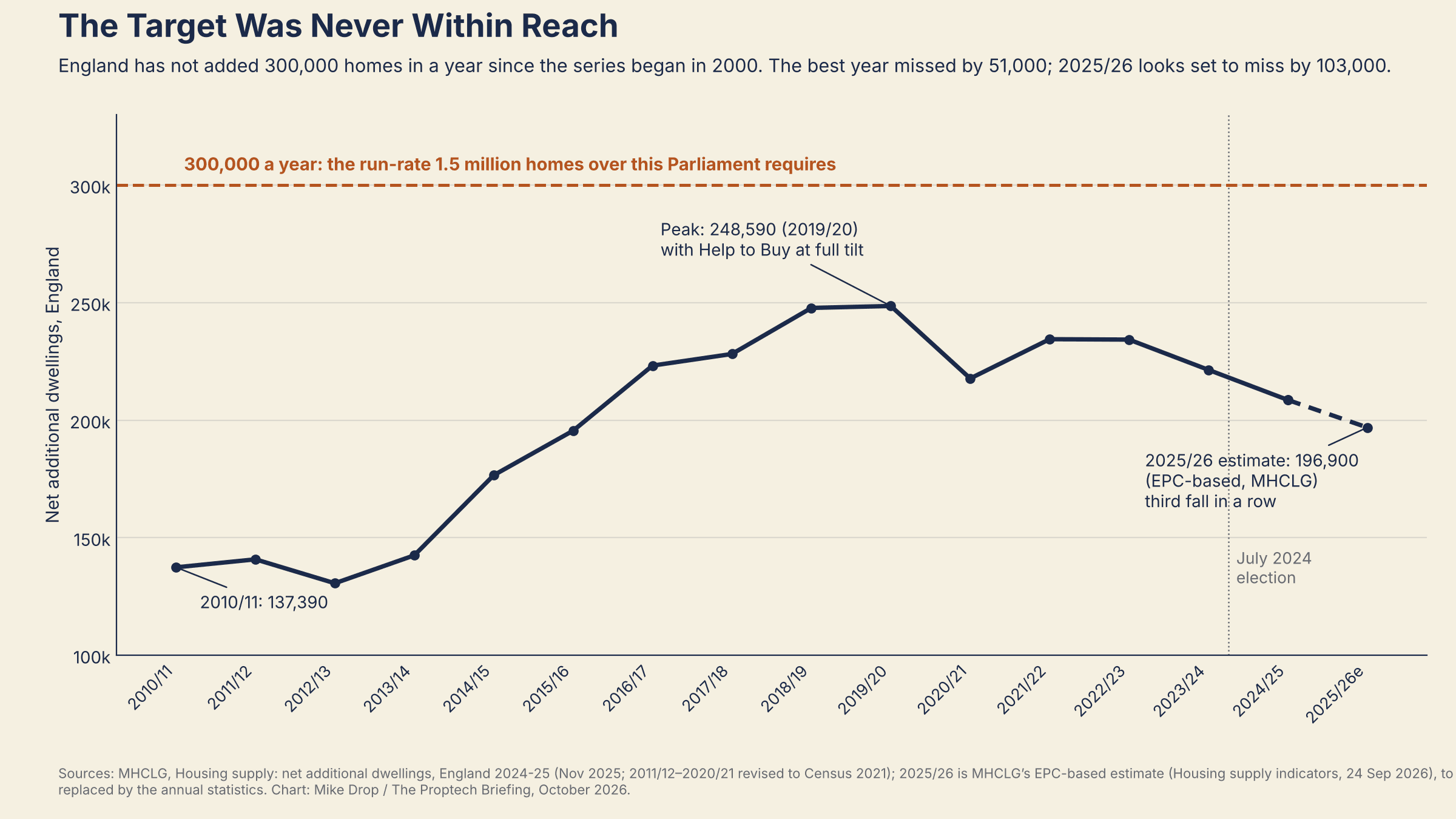
Net additional dwellings in England have never reached 300,000 in a year since the series began in 2000, the run-rate that 1.5 million homes over a five-year Parliament requires. The series climbed from 137,390 in 2010/11 to a peak of 248,590 in 2019/20, with Help to Buy underwriting a fifth of new supply, then fell in five of the next six years. MHCLG’s EPC-based estimate for 2025/26 is 196,900, a third consecutive decline and the lowest since 2015/16. The government’s own count of net additions since the election stood at around 392,400 by mid-June; BCIS puts it at roughly 437,900 by late September, 29% of the target with 44% of the Parliament gone.
So what? The pledge required doubling output from a declining base, in a series whose best year was 17% short of the run-rate; a government that quietly retires the number is acknowledging the series. The decision-relevant point is what replaces it: the Budget’s extra £1.5bn for social and affordable housing, a £4.7bn equity loan scheme and a wider brownfield exemption from biodiversity net gain are measures that lift the floor rather than the ceiling, and that is the right order of priorities for a cycle in which private sales are the constraint. The OBR’s October forecast now carries “a weaker profile for housing supply in the near and medium term” and attributes part of it to a decade of regulatory and fiscal costs outside planning. Anyone underwriting land on the assumption of a policy-driven recovery in private completions before 2028 should look at where the line has been going.
Source: MHCLG, Housing supply: net additional dwellings, England 2024-25 (November 2025; 2011/12 to 2020/21 revised to the 2021 Census); 2025/26 is MHCLG’s EPC-based estimate from Housing supply: indicators of new supply, April to June 2026 (24 September 2026), to be replaced by the annual statistics due on 26 November 2026.
gov.uk · gov.uk · bcis.co.uk · gov.uk · assets.publishing.service.gov.uk
5) Number of the Month
£76,000 – the amount that new taxes, levies and inflation have added to the cost of building each new home, according to the Home Builders Federation and Quantum Development Finance’s quarterly survey of SME housebuilders, in which 84% named development viability as the main constraint on supply.
So what? Put that against the Building Safety Levy (live since 1 October, over £100 per square metre in central London), the Nature Restoration Levy, higher affordable contributions and six-per-cent mortgage rates, and the demand lever is being pulled against a cost lever the government’s own policies push the other way. A 2.5% deposit scheme moves the buyer’s first £5,750; it does nothing about the developer’s £76,000, which is why 96% of SME builders are reluctant to invest. The Budget’s answer on the cost side was one item, more brownfield sites exempted from biodiversity net gain with thresholds to follow. Everything else stays, and landlords got two more points on top. The OBR, in the same day’s forecast, said the quiet part: building safety, biodiversity and nutrient rules, the developer tax and higher corporation tax “have increased the cost, complexity, and timescales associated with residential development” and “weighed on housebuilding activity to a greater extent than we had previously assumed”. The Treasury’s own forecaster has just agreed with the builders.
mortgagesolutions.co.uk · eddisons.com · gov.uk · assets.publishing.service.gov.uk
6) Operator Play of the Month
Put your listings where the buyer’s assistant already is. Zillow launched a connector that lets Claude users search its listings, see prices, Zestimates and affordability tools, and from the same conversation request a tour, connect with an agent or explore financing, with no data sent to Anthropic and broker attribution preserved. In the same fortnight Australia’s PropertyMe (6,500 agencies, two million properties) launched a read-only connector linking Claude and ChatGPT to live agency data, and Cotality’s Trestle opened MLS listing data to approved AI apps. CoStar, reporting record Q3 revenue of $952m, expects AI to save around $200m next year and paid $730m in cash for aerial-imagery business Vexcel.
So what? Last month I said listings would increasingly be read by machines before people. This is what it looks like: the portal keeps the data, the attribution and the lead, and hands the conversation to whichever assistant the customer already uses. The play for any UK agent, operator or portal is to publish a controlled, read-only connector before a competitor’s data becomes the default answer, and to negotiate lead-routing terms while the AI platforms still need the inventory. Watch pricing: nobody has disclosed what a tour request originated inside an assistant is worth, and that number decides whether portals have gained a channel or lost a front door.
investors.zillowgroup.com · realestatenews.com · proptechconnect.com · realestatenews.com
7) Policy & Regulation Radar
The Budget’s property and founder measures in one place: capital gains tax stays at 18% and 24%; Founders’ Relief arrives on 6 April 2027 at 10% on up to £10m of lifetime gains per individual, subject to a 25% founding stake held five years, five years’ UK residence and company tests on turnover (£10m-plus), headcount (15-plus) and growth (25% compound in revenue or staff, or £1.5m of R&D), with the consultation open to 30 November; EMI limits double to £120,000 for companies outside the scheme; Business Asset Disposal Relief falls to £500,000 the same day; property and savings income tax rises to 24%, 44% and 49% from April 2027; the £2m-plus council tax surcharge proceeds from April 2028 with a 100% premium on homes empty for a year; stamp duty, EIS, SEIS, VCT and inheritance tax reliefs are unchanged; the Lifetime ISA charge drops to 20% now and a First Time Buyer ISA replaces it from 2029; land sold to social housing providers becomes VAT-free; and mayors keep 20% of business rates from 2027. Alongside it, a Data Centre Covenant sets the terms (grid-cost contribution, local benefit plans, efficiency and security tests) on which “strategic” data centres get reserved grid capacity and, exceptionally, on-site generation, against a stated need for 6GW by 2030. So what? Three things for this readership. First, the exit maths changes on 6 April 2027: a qualifying founder keeps 90p in the pound on the first £10m rather than 76p, which makes a 2027 completion worth structuring around and the definition of “founding stake” the most important paragraph in the consultation. Second, the state has priced compute’s claim on the grid and written it into policy while housing’s claim is left to local plans; developers near Growth Zones will compete for connections with a covenant-backed counterparty. Third, nothing here lowers the £76,000, and the landlord tax rise is the fourth structural hit to private landlords in a decade, which the OBR itself expects to push rents up: the government is taxing out the small landlord faster than build-to-rent can replace them.
gov.uk · gov.uk · gov.uk · cityam.com · unbiased.co.uk · thenegotiator.co.uk
The Building Safety Levy is live and the Gateway 2 queue has grown with it: the levy applies to building-control applications from 1 October for schemes of ten-plus homes, at per-square-metre rates set by local authority (Kensington & Chelsea £100.35, County Durham £12.70, half rate on brownfield), payable before completion and expected to raise £3.4bn over a decade. Higher-risk building submissions jumped from 17 in July to 64 in September as developers raced the deadline, taking the Gateway 2 caseload to 1,706; the good news is 96% of recent new-build decisions were approvals at a median 23 weeks, against 39% and 43 weeks a year earlier. The Remediation of Unsafe Cladding Bill, introduced on 14 October, adds penalties of up to £500,000 and a 2029 backstop. So what? The regulator has fixed its throughput just as the tax has arrived, so high-rise programme risk falls while cost rises. The surge is partly pull-forward, so Q1 2027 submissions will show the true post-levy appetite for tall residential, and the early read from Canada Water and Lewisham is not encouraging.
eddisons.com · constructionenquirer.com · gov.uk
Awaab’s Law is coming to the private rented sector: a consultation open to 18 December would extend the hazard-repair deadlines that bind social landlords to the roughly nine million privately rented homes. It lands alongside the PRS database (West Midlands from 15 December, London from 15 July 2027, full enforcement from 15 September 2027), the four-point rental tax rise and the Renters’ Rights Act’s tribunal rent challenges. So what? Each measure is defensible alone; together they are a compliance stack only professional landlords and agents can carry, which is the point. Property-management software that turns these deadlines into workflows has a captive market and a statutory sales calendar; the smallest landlords have one more reason to join the growing share of sellers who used to let.
gov.uk · simmons-simmons.com · rightmove.co.uk
AI Growth Zones now come with a price list: the updated policy paper confirms electricity discounts from April 2027 for data centres of 500MW-plus (up to £24/MWh in Scotland) and 100% retention of business-rate growth by host councils for 25 years; CX Tech has proposed a £16.5bn, 1GW campus at Chapelcross; the Prime Minister has rejected a moratorium; and Microsoft withdrew from the Nscale Essex project, which would have been Britain’s largest AI data centre, over grid capacity. Spotlight on Corruption found officials held 137 meetings with businesses and two with community groups while drafting the policy. So what? The state is subsidising the power price for compute and, after the Data Centre Covenant, reserving grid capacity for it, while housing competes for the same connections and labour with no mechanism to weigh one against the other. The business-rates deal is the tell: councils will be paid to say yes to data centres and, in effect, fined for saying yes to homes.
gov.uk · proptechconnect.com · resultsense.com · cityam.com
Planning is being digitised from the evidence base upwards: the first draft Environmental Delivery Plan under the Nature Restoration Fund, for nutrient neutrality in Norfolk, closed for consultation on 27 October and could release up to 15,780 homes; MHCLG Digital launched a standardised “submit a site” tool that turns drawn boundaries into GIS data for local-plan calls for sites; and the ALIGN tool will model power and water capacity against planned growth. The London Assembly’s call for evidence on AI in planning closes 26 November. So what? The levy-funded EDP is the first real test of whether a national fund unlocks sites faster than site-by-site mitigation did; Norfolk’s 15,780 homes are the benchmark. The data tools matter more quietly: standardised site submissions and capacity models are the inputs land-sourcing and viability software has been reconstructing by hand for a decade.
naturalengland.blog.gov.uk · mhclgdigital.blog.gov.uk · mhclgdigital.blog.gov.uk · london.gov.uk
8) Deep Dives on Hot Topics
Special: The target is dead. What dies with it, what survives, and what SME builders and their lenders should do now
The FT’s report that Labour’s 1.5 million homes pledge is “effectively dead” inside government changes less than it appears, because nobody building homes believed it, and more than it appears, because a government that has stopped defending a number behaves differently from one still pretending. Savills’ arithmetic, as reported, is 856,000 completions over the five years to March 2029, 57% of the pledge, with 450,000 to 480,000 built since the election; the Chartered Institute of Housing’s autumn briefing puts the shortfall at around 500,000, a third. The housing secretary told the BBC in September there was a “slim chance” and now calls it a stretch target. The HBF’s Neil Jefferson made the only point that matters: the target was always incredibly challenging, the need has not gone anywhere, and the industry needs a framework it can operate in.
The month’s data describe that framework failing on the cost side. NHBC’s Q3 registrations fell 13%, with the South East down 32% and London registrations down from 5,130 in Q3 2019 to 1,223. The HBF and Quantum survey found 61% of SME builders expecting to start fewer homes next quarter, double the share at the start of the year, 58% expecting to buy less land and £76,000 of new taxes, levies and inflation on the cost of each home. Bellway, which grew completions 10.8% last year, guided to a fall of up to 7% this year with margins dropping further. And London has effectively been declared uninvestable by Taylor Wimpey, British Land and Landsec inside three weeks, with 56 schemes and 3,913 homes paused mid-construction and 4,629 completed new-builds unsold.
The Budget’s response came in three parts. First, demand: Your First Home, confirmed at £4.7bn of government-backed lending for around 70,000 households from spring 2027, with a 2.5% to 15% deposit, a 20% equity loan interest-free for five years, income caps of £110,000 outside London and £140,000 inside, price caps from local-authority medians (£650,000 inner London, £500,000 outer), an annual funding limit and a sliding-scale developer contribution. Second, grant: a further £1.5bn for social and affordable housing, taking ten-year capital investment above £40bn, with the Prime Minister promising the biggest council housebuilding push since the post-war period. Third, devolution: £285m next year for mayoral authorities, a £1.5bn borrowing facility from 2028 and Green Book rules that appraise housing and transport together. On the cost stack, one concession: more brownfield sites exempted from biodiversity net gain, with thresholds still to be set, and a pledge of no major building-regulation changes this Parliament except for safety. No stamp duty change, no relief on the Building Safety Levy, no change to affordable requirements in London, and property income tax rises by a further two points from April 2027, to 24%, 44% and 49%.
So what survives the target? Three things, and they are the ones I would build a business plan around. The social and affordable programme survives, because it is the lever ministers control directly, and the grant-funded, registered-provider end of the market will be the steadiest source of starts in 2027. SME development survives wherever viability does, which the HBF data say is the Midlands, the North East, Wales and Scotland, not the South East and London; a lender or builder whose geography follows approvals rather than headlines will have a better 2028. And the finance gap survives, because the volume builders are guiding down, the banks are not returning to small sites, and the money that is arriving is forward flow from non-bank balance sheets that want origination they cannot replicate, of which CrowdProperty’s £100m from ColCap is this month’s example.
What dies with the target is the assumption that policy will rescue the private new-build sales rate. The Help to Buy evaluation I covered last month attributed around 15% of new builds over the scheme’s decade to it; Bellway’s own scenario for the new one is a 10% volume uplift; Zoopla puts it at up to 30,000 buyers a year and around half the impact of the original; the government’s own figure is 70,000 households over the scheme’s life and 20,000 additional homes. All useful, none transformational, and all arriving from spring 2027, after a year in which the pipeline that feeds 2028 has already shrunk.
Applying the operator, investor, Chair and capital lenses together: operators should re-cut their land pipeline by region and tenure now, treating London and the South East as finish-and-exit markets and the Midlands and North as start markets, and should price the £76,000 into every appraisal, because the Budget removed none of it. Investors in listed housebuilders should read September’s share price jump as a view on 2027 absorption and October’s guidance as a view on 2027 volume, and notice that they point in different directions. Chairs of housing associations and councils should recognise that the grant programme has just become the most reliable demand in the market and staff up to spend it, because capacity, not capital, is their constraint. Capital providers should look at where the forward-flow lines are being signed: the lenders attracting committed two-year money are the ones with origination that banks cannot build and data that funders can diligence, and in a market where 96% of builders are waiting for certainty, certainty of funding is the product.
ft.com · uk.finance.yahoo.com · property118.com · hbf.co.uk · mortgagesolutions.co.uk · investegate.co.uk · propertyindustryeye.com · planninggeek.co.uk · gov.uk · financialreporter.co.uk · thenegotiator.co.uk · stratford-herald.com
Special Deep Dive: What a fintech conference just told me about property. Inside Goldman Sachs’ EMEA Fintech Conference 2026
Written from a day at Plumtree Court on 6 October. Nothing on the agenda mentioned property. Almost everything on it applies. Figures are as stated by speakers on the day unless a published source is linked below.
I built CrowdProperty in the overlap between proptech and fintech, the part of the Venn diagram where the problem is a building and the product is capital. So I went to Goldman Sachs’ fifth EMEA Fintech Conference to listen to people who never think about planning consents or build costs, and to work out which of their lessons the built environment will be living with in two years’ time. The agenda ran from investors (OTPP, TPG, TCV, Prosus) through Airwallex, digital-asset infrastructure (Blockdaemon, Elliptic, Elwood), AI credit decisioning (Taktile, Auxmoney), SumUp, Revolut’s head of machine learning, TrueLayer and ClearBank, Bastion and Mambu, Satispay and Swan, and retail wealth. Six threads carry straight across to property.
1. Credit decisions are moving from weeks to a day, and the moat is the outcome data, not the model
The most directly relevant session was on AI in lending. Taktile, whose decision platform runs underneath Monzo, Mercury and Pleo and which raised $110m from Goldman Sachs’ own growth fund in June, said consumer lending is already automated and the value of AI there is optimisation; the frontier is complex underwriting, meaning mortgages and SME credit, where most banks still take weeks and everyone in the room knows it can be intraday. Its example was a US customer that moved from roughly 20% to 80% automated approvals once financial spreading was automated: PDF accounts turned into a consistent set of ratios so the applicant can be quoted in the moment. Auxmoney, which lent €2bn in Germany and the Netherlands last year (up 37%) and is Europe’s second-largest consumer ABS issuer, told the room it has cut losses by around 60% over four years while the German economy went nowhere, with a fraction of the headcount a bank would carry for the same volume.
What both said about the moat matters more than the automation. Auxmoney does not use AI at the moment of the credit decision; its scorecards stay fully explainable, because a rejected customer must be told why. AI sits in document verification, fraud (a patent-pending model reads KYC video calls for coached-scam behaviour) and pricing intelligence. The durable asset is nineteen years of application, behavioural and device data matched to repayment outcomes years later. Taktile’s version, which its public benchmarks and the Insights product it launched this week are built around: record the data at every decision step so every decision can be replayed and every threshold tuned on a counterfactual, and treat evaluation datasets as the most valuable, most under-invested asset a lender owns, worth more than the choice of model vendor, which changes every few months.
So what? Development finance is the most document-heavy, judgement-heavy corner of property credit, which is exactly the frontier Taktile described. Appraisals, cost plans, contractor CVs, planning conditions, valuations and monitoring reports are the financial-spreading problem in a different file format. A lender that structures those documents consistently can quote an SME developer in days rather than weeks, and in a market where 61% of SME builders expect to start fewer homes next quarter, speed of certainty is itself a form of credit. But the Auxmoney lesson is that the underwriting edge comes from loan outcomes matched back to what was known at origination, which only a lender with a long book and clean decision records has. A subtler point: business lenders learn even from applicants who went elsewhere, because defaults still show up; consumer lenders learn only from customers they served. Specialist property lenders hold the better position and most have never organised their data to use it. Start recording decision-time data now; it cannot be reconstructed later.
2. “Agentic” has a definition in finance, and it is the account, not the chatbot
Airwallex ($1.3bn of annualised revenue growing 74%, raised at an $11bn valuation in June) launched Agentic Business Accounts in late September, exposing its payments, FX, treasury and spend primitives to AI agents on top of the MCP server and agent tooling it shipped in June. Its CFO’s example was a holiday-rentals business with 500 villas whose owner, with no technical background, rebuilt the whole finance stack on wallets and agents. His framing of autonomy was the one Boards will recognise: agents operate below a delegated limit, humans above it, exactly as a Board delegates spending authority to a CFO. The strategic claim was that in a world where a human account and an agent account must be linked, whoever holds the account holds the position.
So what? Property management is a collection of recurring, rules-based money movements: rent in, deposits held, service charges apportioned, contractors paid, arrears chased. That is the easiest category of finance for an agent to run and the hardest for a point solution to defend, because the agent will sit wherever the money sits. For letting and block-management software the question is no longer whether to add an AI assistant; it is whether the client money account becomes the platform, and who owns it. Operators should treat the delegated-limit model as the governance template: write down what an agent may move without a human, and audit it like any other mandate.
3. The infrastructure for 24/7 tokenised settlement is arriving, and the weak link is compliance, not custody
The digital-assets panel described 2026 as the year of production-grade tokenisation. DTCC’s tokenisation service, tested live in July with Goldman Sachs, BlackRock and JPMorgan in the working group, went into full production on 28 October with twenty participants signed, including JPMorgan, Morgan Stanley, Citi and Barclays; Blockdaemon, which supplies the wallet infrastructure behind it, said DTCC went from not being a customer a year ago to its largest. Custody and execution are solved problems. The fragmented middle layer, compliance and risk decisions that assume a human at every step and batch processing overnight, is what breaks in a 24/7 multi-chain market. Elliptic measured a 522% rise in transactions on agentic rails between June and August and has published an eight-principle standard for on-chain risk decisions when the counterparty is an agent, against industry projections of more than $3tn of agent-facilitated spending by 2030.
So what? This is the piece missing from most property tokenisation pitches. Last month I noted the FCA’s priority is wholesale post-trade and collateral, not retail property, and this panel explained why the institutional plumbing goes first: the registry, the settlement rail and the compliance engine have to run continuously before anyone tokenises a building that trades twice a year. Property tokenisation will inherit that infrastructure rather than build it, so the defensible position for a property platform is origination, asset quality and servicing, not the tokenisation itself. That is the same conclusion I reached in Dubai, from the opposite direction.
4. Productivity gains are real, headcount is flat, and the SME segment has become serviceable
The investor panel put numbers on AI that most proptech Boards have not yet seen in their own companies. One TCV portfolio company halved customer support headcount while growing two and a half times over eighteen months. Engineering productivity is up two to ten times since the current generation of frontier models, with one company two and a half to three times more productive than six months ago, and another growing 40% with a flat engineering team. A Prosus portfolio saw token usage rise five to ten times over six months at flat or slightly falling cost. The point they were most animated about was go-to-market: AI makes outbound and inbound automatable, which changes the economics of serving fragmented, high-churn small businesses, the segment nobody could serve profitably. Airwallex’s CFO added the budgeting rule: FTE cost, contractor cost and token cost are one envelope, and functional leaders allocate within it.
So what? Nearly every proptech sells into a long tail: SME developers, independent letting agents, small landlords, sub-contractors. The historical answer was to ignore them or to sell through an aggregator. If the cost to serve has fallen by the amounts described, the addressable market of most UK proptech businesses just grew, and so did the number of competitors who can reach it. Investors said plainly that a portfolio company without an AI strategy is now a concern, and that the minimum bar is a credible plan to optimise, automate and cut cost. For a Chair, the practical test is whether management can show the cost envelope, not whether it has a copilot.
5. The exit maths has changed: $5bn to go public, and strategics are the buyers
The investors were consistent. IPO is a milestone, not a life event; below roughly $5bn of market capitalisation they would keep companies in the private markets, which are getting healthier every year; concentration in public markets is pulling flow away from small and mid caps, so subscale listings get less attention and lower multiples; and a 19% result against a 20% expectation is now a “big miss” that pod shops and factor baskets can turn into a 10% share price move. The other exit is strategic M&A at $10–20bn, for which the advice was to build C-suite relationships with potential acquirers and meet them once or twice a year. On the pressure to return capital: 2021 vintages invested at zero rates with leverage will not generate underwritten returns, and the choice is to wait for performance or take the loss now, which most have not yet done. The backdrop, from the opening remarks: 1,100 private-equity-owned assets in EMEA, with around $4tn of enterprise value, held for more than five years.
So what? Proptech has produced very few companies anywhere near $5bn, so for almost every founder in this sector the exit is a trade sale, and last month’s briefing showed what those look like: CoStar, Procore, Schneider and Venn paying for data layers and installed bases. The useful discipline is the one TCV described: know who the three plausible acquirers are, understand what they have failed to build, and be in the room before you need to be. The 2021-vintage problem also sits inside proptech portfolios, and the secondary and continuation activity it drives will set the prices at which the next round of consolidation happens.
6. Rails are being rebuilt underneath payments, and property’s money still moves on the old ones
TrueLayer now runs more than $150bn of annualised volume across 25 million-plus consumers, with Amazon its fastest-growing customer and 40% to 80% share of wallet in its strongest markets, and has moved from debit into credit by acquiring Dutch BNPL provider in3, with the credit funded by the merchant rather than the consumer; Europe’s domestic wallets (Wero, Bizum, MB WAY, Bancomat, Vipps MobilePay) have meanwhile formed a single interoperability entity covering 130 million users in 13 countries. ClearBank, the first new UK clearing bank in 250 years, sits behind Tide (around 15% of UK small businesses), Wealthify and Revolut savings, was the first Dutch credit institution approved under MiCA, runs EURC and USDC rails with Circle, and said US stablecoin volumes are approaching those of a major card network while UK issuance waits for legislation. SumUp, with four million-plus merchants in 38 markets, reminded the room that half of European payments are still cash and that it already files tax returns with HMRC straight from the point of sale. Revolut’s head of machine-learning engineering, Nikolay Donets, described PRAGMA, a transformer trained on the firm’s own transaction event stream that beats its classical models across fraud, credit and lifetime value from one shared representation (2.3 times the accuracy on credit default, 65% more fraud caught, per the published paper), and said the one piece of intelligence a financial institution cannot buy is its own transaction history.
So what? Rent, deposits, service charges and completion monies in the UK still move by bank transfer, cheque and solicitor’s client account. Pay-by-bank with merchant-funded credit is a description of a rent-collection product, and the European open-banking stack now has the trust and the volume to carry it. Stablecoin settlement is the obvious rail for cross-border property investment flows, which is why Dubai got there first. Revolut’s point is the one that should stay with every proptech Board: the model is replaceable, the proprietary event stream is not, and most property businesses are not yet capturing theirs.
Applying the operator, investor, Chair and capital lenses together: operators should pick the one workflow where decision speed is the product, usually credit or onboarding, structure the documents behind it and start recording decision-time data, because that record becomes the asset. Investors should underwrite proptech lenders and marketplaces the way this conference underwrote fintech: outcome data, funding diversity, explainable decisions and a cost envelope, with the exit priced as a trade sale. Boards should ask for three things by the next cycle: an AI plan that is more than a copilot, a delegated-limits policy for anything agentic that touches money, and a named list of strategic acquirers with a relationship owner. Capital providers should read Auxmoney’s ABS programme as the destination for well-run specialist lenders in any asset class: public, through-the-cycle loan performance data is what turns a funding line into a capital markets programme, and the ones that start keeping that data now will be the ones who can issue when the window opens.
growth-strategy.com · airwallex.com · airwallex.com · taktile.com · labs.taktile.com · euromoney.com · dtcc.com · blockdaemon.com · digitaltransactions.net · truelayer.com · thepaypers.com · coindesk.com · businesswire.com · arxiv.org · revolut.com · sumup.com · mambu.com · beinsure.com
Proptech × Fintech Intersect
Specialist lenders are splitting into those who can issue and those who cannot: Together priced its £409m CRE7 securitisation of small-balance commercial loans, 98.2% first charge, around 83% rated AAA, at a 95% advance rate, its fourth transaction in four months; LendInvest’s £300m Mortimer 2026-1 and Paragon’s second covered bond preceded it. At the other end, administrators of Market Financial Solutions now put the shortfall at £1.3bn, up from £930m in March, with only around £230m of £1.16bn of collateral realisable and two of the group’s bridging vehicles expected to return 9 to 13 pence in the pound. The founder denies wrongdoing and the allegations are untested. So what? The lesson the Goldman Sachs credit panel put best applies here: a lender with clean decision records and public, through-the-cycle performance data becomes a capital markets programme; one without them becomes a creditor meeting. UK specialist property lending is being sorted on exactly that line, and forward-flow partners and securitisation investors are doing the sorting.
mortgagesolutions.co.uk · investegate.co.uk · caproasia.com · briefs.co
Embedded property finance is being funded with debt, as it should be: Homeward raised a $120m Series D alongside a $330m asset-backed facility, at a valuation roughly flat to 2021; Singapore’s Rently secured a $12m credit facility to expand rent-now-pay-later in the UAE, where it has written more than AED 100m of rental contracts; and fractional ownership raised on both sides of the Gulf, with Saudi Arabia’s Ghanem extending its pre-seed to $8.6m inside the regulator’s sandbox and US platform Mogul raising $15.5m at a $126m valuation. So what? A flat valuation after five years and a $330m debt line is what a sensible embedded-finance outcome looks like in 2026: the equity is for the product, the debt is for the asset, and the multiple is a lender’s multiple. The Dubai conclusion from last month holds across the category. Investors should diligence these as credit, and founders should expect to be valued as one.
news.crunchbase.com · wamda.com · wamda.com · proptechconnect.com
The UK’s crypto and stablecoin timetable is now fixed, and it is slow: the FCA’s cryptoasset authorisation gateway opened on 30 September ahead of a regime that starts in full on 25 October 2027; the Bank of England’s systemic stablecoin code is due by year end with a £40bn issuance guardrail per coin; and the joint tokenisation roadmap is still promised for later in 2026. ClearBank told the Goldman Sachs audience that US stablecoin volumes are approaching those of a major card network and that it cannot issue in the UK until legislation arrives. So what? Twelve months of regulatory lead time is a long wait when the settlement rail you want is already carrying real volume in the US and Europe. For UK property platforms the practical consequence is that cross-border investment flows, the most obvious stablecoin use case in real estate, will be built on EU-licensed rails first, which is where ClearBank has positioned itself.
farrer.co.uk · freshfields.com · fca.org.uk · fca.org.uk
AI in Real Estate
EliseAI and RealPage: the integration wars have started, and the prize is the system of record: a month after raising $350m at a $4bn valuation from a16z and Bessemer, with more than $200m of ARR and a claimed one in six US apartment units, EliseAI was cut off from new RealPage integrations on 7 October. RealPage’s chief executive Dirk Wakeham says EliseAI breached a years-old agreement limiting it to agreed use cases by launching Apollo, an agent that works across every multifamily role, and never submitted it for review; EliseAI called the claim false. Six days later RealPage made Funnel, a direct competitor, its front-office partner, and on 27 October Thesis Driven reported, citing operators who have seen it, that EliseAI is building an AI-first property management system for launch in early 2027. So what? This is the Venn-and-Zuma logic from last month running to its conclusion. An agent that handles leasing, renewals and collections does not need the incumbent’s features, only its data, and when rebuilding becomes easier than integrating, the platform stops being a moat. RealPage’s answer, becoming the “source of truth” inside a friendlier front office, is the right defensive move. Entrata was the last challenger to break into institutional multifamily, in 2013, and the edge cases that protect a PMS (tax-credit compliance, fair housing, accrual accounting) are real, so the switching question is open. But every proptech that lives on an incumbent’s API should read Wakeham’s letter and assume the door can close; the lesson for founders is to own a workflow the system of record cannot see.
globenewswire.com · multifamilydive.com · multifamilydive.com · thesisdriven.com · keithbrown.com
Leasing and resident communication is where agentic AI has found its buyer: VerbaFlo, which raised a $7m seed led by Pi Labs in March, won Residential Innovation in PropTech and Best Use of AI in Property at the Property Week Tech Innovation Awards on 16 October, with its founder Sayantan Biswas highly commended as PropTech Leader of the Year, was a Technology of the Year finalist at the Coliving Awards, and on 13 October signed a Seed Group partnership to take its platform to UAE property operators; its published Londonist case study reports around three times the enquiries and 46% more bookings with 80% of conversations automated. Lette and Vessla raised in the same fortnight for the same workflow. So what? Awards are not revenue, but the pattern across four companies on three continents in one month is: the enquiry-to-lease workflow has a measurable baseline, a budget holder and a clear outcome, which is why it is the first property process to be sold on results rather than seats. The next contest is for the voice channel and, as EliseAI shows, for the system of record itself; the UAE, where everything is a financial product and tenants pay annually, is a sharper test of whether an agent can carry a transaction, not just a conversation. (Disclosure: VerbaFlo is a Pi Labs portfolio company; I am a Pi Labs Venture Partner and Investment Committee member.)
proptech.propertyweek.com · proptech.propertyweek.com · proptechconnect.com · verbaflo.ai · tech.eu
Procore has moved from buying data to shipping agents: at Groundbreak on 21 October it launched the first DataGrid agents from its January acquisition, including a submittal agent that updates up to 500 submittals at once (built with McCownGordon, bulk submittals having been the third most-requested feature), a procurement-log agent in closed beta, a voice-first mobile app, a “Hey Procore” integration with Meta’s AI glasses and its first MCP connection; EarthCam followed with a tenth-generation integration that lets site managers ask the agent about deliveries, equipment and PPE violations, and Newforma bought Lumi AI for natural-language answers on project data. So what? Six weeks after closing the DroneDeploy acquisition, Procore is showing what the data was for. The submittal agent is the template: a tedious, high-volume, contractual workflow where the owner’s and contractor’s incentives align and the output is auditable. Point solutions that automate a single step of a project record now sit inside the platform’s roadmap, and should price their exit accordingly.
enr.com · globenewswire.com · proptechconnect.com
The adoption gap is now measured on both sides of the Atlantic: Deloitte’s 2027 Commercial Real Estate Outlook finds 92% of executives still researching or piloting AI and only 8% with it integrated, even as more than 90% plan to raise data and technology spending; JLL’s Global State of Facilities Management report, from 1,321 organisations, finds 45% scaling AI in facilities management today with 86% expecting to by 2030, robotics rising from 37% to 71% over the same period, and around 90% expecting spend to shift from labour to technology. So what? Eight per cent integrated and 90% increasing budget is a market about to buy, and the facilities data says what it will buy first: the operational, measurable, labour-replacing end. That is consistent with the Goldman Sachs investors’ observation that AI is now a minimum bar for management rather than a differentiator, and it means the window for an “AI strategy” slide to satisfy a Board has closed.
The regulated end of the stack is starting to accept machine output: Leeds Building Society and Finova opened “Agentic Apply” to brokers free for three months after more than 1,000 applications in a four-week beta, claiming at least 30 minutes saved per case and multiple decisions in principle from a single fact find; LMS and Veyco launched qualified electronic signatures for mortgage deeds, which HM Land Registry has accepted since August 2025; and MHCLG confirmed the home-buying reform roadmap, a property-agent code of practice before the end of the year and the first update to the conveyancing protocol since 2019. So what? These are the same “preparatory steps” that the EU AI Act carves out and that Taktile and Auxmoney described at Goldman Sachs: document structuring and verification automated, the decision explainable, the human in supervisory mode. UK mortgage origination is adopting that architecture broker-first, and the lender that owns the structured data from a thousand applications a month has started building the outcome dataset that becomes the moat.
mortgagesolutions.co.uk · mortgagesolutions.co.uk · todaysconveyancer.co.uk
9) Events
Future Proptech Summit, Dubai, 3–4 November 2026 – https://futureproptechsummit.com/
Barratt Redrow AGM and trading update, 4 November 2026 – https://www.barrattredrow.co.uk/investors/financial-calendar
Bank of England MPC decisions, 5 November and 17 December 2026 – https://www.bankofengland.co.uk/monetary-policy/upcoming-mpc-dates
Rightmove trading update, 6 November 2026 – https://www.prnewswire.co.uk/news-releases/regulatory-news/rightmove-plc-statement-re-trading-update-819562279.html
Web Summit, Lisbon, 9–12 November 2026 – https://websummit.com/
Persimmon trading update, 12 November 2026 – https://www.persimmonhomes.com/corporate/investors/financial-calendar
Cityscape Global, Riyadh, 16–19 November 2026 – https://cityscapeglobal.com/welcome-to-cityscape-global-2026
MHCLG net additional dwellings 2025-26 published, 26 November 2026 – https://www.gov.uk/government/statistics/announcements/housing-supply-net-additional-dwellings-england-2025-to-2026
Founders’ Relief technical consultation closes, 30 November 2026 – https://www.gov.uk/government/consultations/founders-relief-technical-consultation
RE:UK and UKPA UK PropTech Awards, London, 26 November 2026 – https://realestateuk.org/reuk-events
PRS Database registration opens (West Midlands first), 15 December 2026 – https://www.simmons-simmons.com/en/publications/cmuo5jjpw000iujr40p4c0kyr/prs-database-register-your-rental-property-service-launching
Pi Labs Growth Programme applications close, 29 January 2027 – https://pilabs.vc/growth-programme
PropTech Connect Middle East, Dubai, 3–4 February 2027 – https://proptechconnect.com/
ULI UK Conference, London, 9 February 2027 – https://adventuresincre.com/events/event/uli-uk-conference-2027/
MIPIM 2027, Cannes, 16–19 March 2027 – https://www.mipim.com/
PropTech Connect Europe 2027, London, 8–9 September 2027 – https://proptechconnect.com/event-europe/
UK Events Programme: UK PropTech Association (UKPA) Events – https://ukproptech.com/events/
US events calendar – PropTechVision: https://www.proptechvision.com/proptech-events/
10) Further Reading
Housing Pipeline Report Q2 2026 (Home Builders Federation). So what? The report is back, and the two-year-forward indicator for completions is at its lowest since 2013. https://www.hbf.co.uk/news/housing-pipeline-report-q2-2026-published-september-2026/
SME housebuilders say market pressure is choking development (Mortgage Solutions, on the HBF and Quantum Development Finance survey). So what? The source of this month’s Number of the Month and the clearest statement of what SME builders needed from the Budget and mostly did not get. https://www.mortgagesolutions.co.uk/specialist-lending/commercial-finance/2026/10/27/sme-housebuilders-say-market-pressure-is-choking-development/
Labour’s housebuilding target ‘effectively dead’ (Financial Times). So what? The report that moved the target from pledge to stretch target, with Savills’ arithmetic. https://www.ft.com/content/285af47d-a0cc-4038-a5e6-9639a793e5ee
Budget 2026: breathing space for today, hope for the future (HM Treasury). So what? The primary source on Your First Home, the £1.5bn for social housing and the landlord tax rise. https://www.gov.uk/government/news/budget-2026-breathing-space-for-today-hope-for-the-future
Economic and fiscal outlook, October 2026 (OBR). So what? The forecaster’s verdict that building safety, environmental and tax measures have weighed on housebuilding more than it assumed, plus house price, transaction and mortgage-rate paths to 2031. https://assets.publishing.service.gov.uk/media/6ae1f7b839d29f3f9b9b3f36/economic-and-fiscal-outlook-october-2026-web-accessible.pdf
Founders’ Relief: technical consultation (HM Treasury). So what? The conditions that decide who gets the 10% rate; responses close 30 November. https://www.gov.uk/government/consultations/founders-relief-technical-consultation
Exclusive: EliseAI is building a property management system (Thesis Driven). So what? The report behind this month’s integration-wars story. https://www.thesisdriven.com/letters/exclusive-eliseai-is-building-a-property-management-system/
Consumer price inflation, September 2026 (ONS). So what? The 3.5% print that locked in expectations of a November rate rise. https://www.ons.gov.uk/economy/inflationandpriceindices/bulletins/consumerpriceinflation/september2026
State of the Market – October 2026 (CrowdProperty). So what? Practical monthly read for SME developers on prices, rates and planning, with the detailed-permissions figure quoted above. https://www.crowdproperty.com/state-of-the-market-october-2026/
Pathways raises $6m to automate manufacturers’ environmental reporting (Dealroom). So what? The most complete account of the round, the investors and the Heidelberg Materials contract. https://dealroom.co/news/162191-pathways-raises-6m-to-automate-manufacturers-environmental-reporting/
Gateway 2 backlog swells again as developers race to beat levy (Construction Enquirer). So what? The best single read on Building Safety Regulator throughput and the levy pull-forward. https://www.constructionenquirer.com/2026/10/08/gateway-2-backlog-swells-again-as-developers-race-to-beat-levy/
Delivering AI Growth Zones (DSIT and HM Treasury policy paper, updated 19 October 2026). So what? The subsidy terms under which compute will compete with housing for power and land. https://www.gov.uk/government/publications/delivering-ai-growth-zones/delivering-ai-growth-zones
Q3 2026 proptech venture funding: $2.21 billion invested as capital moves toward scale and physical assets (CRETI). So what? The quarter’s funding data and the concentration behind it. https://creti.org/insights/q3-2026-proptech-venture-funding-221-billion-invested-as-capital-moves-toward-scale-and-physical-assets
Inside Goldman Sachs’ 11th Disruptive Technology Symposium (Mike Drop, March 2026). So what? The companion piece to this month’s fintech deep dive, on why distribution and power decide the AI decade. https://growth-strategy.com/perspectives/inside-goldman-sachs-11th-disruptive-technology-symposium-ai-winners
The Proptech Briefing, September 2026 (Growth Strategy). So what? Last month’s Your First Home and Dubai deep dives, which this edition builds on. growth-strategy.com
For UK residential property market insights, subscribe to the CrowdProperty UK newsletter – https://www.linkedin.com/newsletters/crowdproperty-market-insights-7081980562445324289
For Australian residential property market insights, subscribe to the CrowdProperty Australia newsletter – https://www.linkedin.com/newsletters/the-in-crowd-7120658903222091778
Mike Bristow
Founder of Growth Strategy. Operator, advisor and investor across strategy, capital, M&A and board roles.
About Mike
Strategy & Growth
Make sharper choices, build sustainable advantage and turn strategic intent into measurable enterprise value.
Capital
Secure and optimise the institutional capital required to lend, invest, acquire, build or scale.
M&A & Transactions
Prepare, position and execute acquisitions, disposals, liquidity events and strategic partnerships.
Board & Executive
Add experienced judgement, challenge and execution capacity at board and executive level.
More perspectives
Proptech Briefing
The Proptech Briefing, September 2026
This edition covers the return of Help to Buy as Your First Home, a rate cycle that has turned from cuts to rises, and incumbents paying for data layers rather than features. Two deep dives: Your First Home, where it is weak and who it really helps, and a special long read from a week on the ground in Dubai.
Read the article
Proptech Briefing
The Proptech Briefing, August 2026
This edition covers England’s new rules-based planning system with its “default yes” for homes near well-connected stations, a 79% collapse in build-to-rent starts, and capital buying control. Deep dive: what the new NPPF changes for developers, lenders and investors, and what it does not.
Read the article
Proptech Briefing
The Proptech Briefing, July 2026
This edition covers a new Prime Minister and Housing Secretary reaffirming the 1.5 million homes target, Pi Labs' 100th investment alongside Balfour Beatty's Fund IV commitment, and why the housing delivery gap keeps widening even as capital keeps flowing.
Read the article
View all perspectives